

Sexual abuse follows a predictable pattern, but unfortunately this pattern is not widely known. It is essential to recognise its early signs and profound effects for both protection and healing.
Due to the many forms it takes, sexual abuse is often difficult to recognise. It insinuates itself tacitly into relationships of trust, whether based on respect or fear. Before any sexual assault, there is almost always a slow and well-calculated process known as grooming.
As it happens gradually, victims usually find it hard to recognise this process as a strategy for manipulation, control, and ultimately abuse. Abusers approach victims with care, attention, and compliments. Initially, they do not behave violently but appear protective, generous, and trustworthy instead. All the while, they are preparing the ground for abuse.
The first step is visible only to the abuser. First, they identify a vulnerable person. They recognise them easily; they are lonely and have few friends, or they may even isolate themselves. They may be going through family or emotional problems. They have an increased need for attention, validation, or support. They also tend to view the abuser as an authority figure, like that of a parent, teacher, mentor, or pastor. The victim’s vulnerability is not their fault. Vulnerability is a human condition. However, the abuser takes advantage of this.
The abuser then begins to build a relationship of trust. They work intentionally to become a special person in the victim’s life, offering constant attention, listening to their problems, positioning themselves as a confidant, and giving the victim the feeling that “no one understands you like I do.” They do favours for the victim and give them gifts. In a religious environment, the abuser may also adopt moral and spiritual language, saying things like: “Trust me, I know what’s best for you;” “God sent me to help you;” or “You are a blessing to me.”
Once trust has been established, the abuser tries to isolate the victim by discouraging friendships and suggesting that their family does not understand them. They create secrets between themselves and the victim. This isolation helps the abuser to create an emotional dependence in the victim.
The next step in grooming is testing boundaries. The abuser makes seemingly innocent gestures, such as accidental touching, telling sexual jokes, giving lingering hugs, sending personal messages at inappropriate times, and asking intimate questions. All the while, they observe the victim’s reaction, pushing the boundaries little by little. If the victim does not protest, the abuser continues. If they do, the abuser plays the victim: “Did I make you feel bad? I’m sorry, I didn’t mean to…”
Once the victim is sufficiently caught up in the relationship, the abuser begins justifying touching or sexual discussions by appealing to emotions, loyalty, or even religion: “This is how you show trust;” “Look how special you are to me;” “True love, as God intended, does not raise barriers;” “You are a pure soul;” “You are God’s plan for me.” By this point, the victim no longer knows what is normal and what is not in this so-called friendship.
Once the boundaries have been eroded, the abuser becomes explicit, asking for intimate images or physically assaulting the victim. The victim may feel ashamed, confused, or even guilty without realising that none of what they have experienced constitutes consent and that they have been manipulated into accepting it. Being controlled is not the same as agreeing.
So, what is consent and what is it not?
Consent is the explicit, conscious and voluntary agreement of an adult. Three essential elements are needed for real consent: freedom, clarity, and continuity.
The absence of opposition does not constitute consent. Silence is not consent. Freezing is not consent.
Freedom is essential because a “yes” is only valid if the person is completely free to say “no” without facing any consequences. In a relationship where there is a power imbalance, freedom is already compromised (the other person is in a superior position).
Then there is the issue of clarity—there is nothing about consent that relies on “guesswork.” Consent must first be asked for, received, and reconfirmed.
Continuity is essential because consent can be withdrawn at any time, even in the middle of a situation. When someone says “I don’t want to anymore,” they are withdrawing their consent, even if they initially agreed.
The entire discussion about consent concerns adults only. Minors cannot give sexual consent to adults. Never under any circumstances. The responsibility always lies with the adult.
How do you recognise abuse?
Sexual abuse is essentially any form of sexual contact or behaviour that occurs without consent. When it comes to minors, consent is not a necessary component to define abuse because the responsibility always lies with the adult. There are no exceptions.
To protect children and help adults who have experienced abuse to recognise it in retrospect, it is important to understand that sexual abuse broadly takes two forms: with and without physical contact.
Touching abuse occurs when a person uses physical contact inappropriately for the child’s age, boundaries, or safety, either through direct gestures or by pressuring the child to touch another person. This includes touching a child’s private parts, forcing a child to touch someone else’s private parts, or playing so-called “games” that put a child in inappropriate situations for their age. It includes any form of intrusive behaviour directed at a child’s body with sexual intent.
Non-touch abuse occurs when a child is exposed to or drawn into situations, images, or conversations with sexual content. Showing a child pornographic material is a form of abuse. So too is photographing the child in inappropriate ways, intentionally exposing the child to adult nudity, or watching the child during moments of intimacy, such as when they are changing clothes or using the toilet.
Both forms are serious and can have a deep impact on the child. They need to be recognised and treated with the utmost seriousness. Understanding these characteristics can help parents to be vigilant and support adult survivors of abuse who are seeking clarity about their past experiences.
Indicators of possible child abuse
Children are rarely able to articulate what is happening to them. However, their bodies, behaviour, and changes over time can convey what they are not yet able to say aloud.
The following signs, when occurring together or repeatedly, require attention. While they do not automatically indicate abuse, they are valid reasons to take a closer look:
1. Changes in behaviour or personality
Sometimes, the first sign is a change in the child’s demeanour: they may become quieter and more withdrawn, or they may suddenly become more “well-behaved,” as if trying not to upset anyone.
Pay attention to:
- Excessively affectionate or sexualised behaviour for their age;
- Fear without a clear reason;
- Sudden regression, such as thumb sucking, clinging to old toys or “baby-like” behaviour;
- Excessive clinging or dependence on parents;
- Exaggerated reactions to criticism;
- Desire to be “perfect” or not to cause disturbance;
- Sudden mood swings.
2. Signs of anxiety, shame or fear
Abuse creates secrets, and secrets weigh heavily. Just because a child cannot articulate a fear does not mean that it is imagined or a manipulative strategy to get attention.
Important signs:
- The child suddenly avoids an adult they used to like;
- They do not want to be left alone with a certain person;
- They get scared when talking about clothes, showering, or changing;
- They have nightmares or start wetting the bed again;
- They vaguely say “I don’t want to” without being able to explain why.
3. Signs related to physical health
Pay attention to:
- Pain, itching, or infections in the genital area;
- Loss of appetite or, conversely, compulsive eating;
- Pain with no apparent cause;
- Severe fatigue or sleep problems.
4. Unusual drawings, games, and conversations
Children process reality through play. When they cannot explain things directly, they express themselves through drawings and symbols.
Signs to take seriously:
- Sexually explicit drawings;
- Games that imitate inappropriate behaviour for their age;
- Jokes of a sexually explicit nature, which are inappropriate for children.
5. Clues related to the child’s relationships
Sometimes, it is not the child’s behaviour that raises red flags, but the behaviour of others towards the child.
Be alert if:
- An adult constantly seeks to be alone with your child;
- The child suddenly becomes silent when that person is mentioned;
- There are overly long hugs, unwarranted touching or uncomfortable jokes;
- That adult offers gifts, attention, or favours that seem unnatural.
A child should never feel obligated, fearful, or confused around an adult.
6. Signs which may indicate physical abuse
Other forms of abuse may accompany or be confused with sexual abuse. Any injury for which there is no explanation, or for which the explanation is unlikely, is worth investigating.
Signs to watch out for include:
- Repeated bruising with no clear explanation;
- Clothing chosen to cover the body, even when it is hot outside;
- Fear of being touched;
- Avoiding sports or changing clothes;
- Self-destructive behaviour.
7. Signs of neglect
Child neglect is also a form of abuse, and a common one too. It manifests itself through:
- Lack of food, hygiene, and care;
- Lack of supervision;
- Exposure to dangerous situations;
- The impression that the child is constantly “on their own.”
It is important to remember that no single sign automatically indicates abuse. However, a group of signs that persist or appear suddenly deserves immediate attention.
How can we protect ourselves?
When it comes to sexual abuse, our instincts often react before our reasoning ability kicks in. However, in many environments where we are asked to “not speak without being asked,” to be “polite,” “obedient,” or to “not challenge authority,” our upbringing can cause us to silence our bodies. It may even make us tell ourselves that we are exaggerating or being “paranoid.” This is why it is valuable to familiarise ourselves with a few essential signs in advance. These can help us to more easily spot situations where our personal space is being violated, giving us the courage to set boundaries even when there is strong pressure to remain silent or be “well-behaved.”
Children
In an ideal world, no child would know what abuse is. Unfortunately, however, the reality is that we have to teach children about it. Education about bodily boundaries is one of the most effective forms of prevention and is consistently recommended by relevant organisations. The recommendations below can facilitate open discussions between parents and children about physical safety.
1. “You’re in charge of your body.”
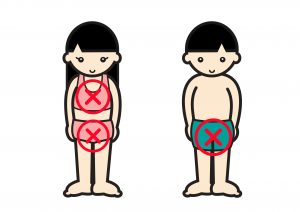
The swimsuit rule is clear, intuitive, and easy to remember, even for young children.
Tell your child: “No one is allowed to touch the areas covered by your swimsuit. Ever. Only a doctor can do that, and only if I’m with you.“

2. “If an adult wants to be alone with you and you feel uncomfortable, leave immediately.”
Abusers look for situations where there are no witnesses. It is therefore vital that children know they can leave the presence of an adult they feel uncomfortable with and seek out someone else they trust.
Tell your child: “If anyone, no matter who, closes the door, turns off the lights, or asks you to go somewhere private, leave immediately and come to me or another trusted adult.“
3. “Your body can send you signals that you are in danger.”
Children can learn to recognise the physical signs of danger, such as a tight stomach, feeling like they want to leave, or feeling afraid for no apparent reason.
Tell your child: “If you feel that something is wrong, you are allowed to leave immediately, even if you can’t explain why.“
4. Surprises are good. Secrets are not.
Children need to know that it is never okay to keep secrets from their parents, no matter what they are. It is helpful for children to understand the difference: surprises bring joy and are revealed quickly; secrets weigh heavily on the conscience, cause fear, and must be kept hidden. They also need to understand that “secrets about the body” are a red flag.
Explain to your child in an age-appropriate way: “If someone asks you to keep a secret about touching, pictures, messages, or meetings, please tell me immediately. I will listen to you without scolding you. I will not blame you in any way.“
5. “You have the right to say no to anyone.”
Children are often taught to be well-behaved. However, unconditionally obeying others makes children vulnerable. That is why they need to be explicitly told that they have the right to refuse, and that it is not rude to say “no.”
Tell your child: “You don’t have to hug anyone if you don’t want to. You don’t have to sit in anyone’s arms or on their lap. You decide. I support you.“
6. “If you ever feel scared, confused, or ashamed, come straight to me.”
Abusers rely on the shame and fear experienced by children. Therefore, one way to protect children is to build their confidence by showing them that their parents will always believe and defend them.
Tell your child: “No matter what happened, I’m not here to punish you, but to protect you. If something scares you or you don’t understand something, come to me immediately. I’m on your side.“
7. “Let’s play the ‘No’ game!”
Children learn much more easily through play. Repeating hypothetical situations—such as how to say “no,” how to leave a room, and how to find a trusted adult—prepares children to react confidently when they need to without panicking.
Tell your child: “Let’s play practising saying ‘no’, walking away, and going to a trusted adult.“
8. “You have three trusted adults you can go to anytime.”
Sometimes parents are not immediately available. It is important that children know exactly who to turn to. You can choose those adults together.
Tell your child: “If I’m not with you, you can go to any one of these three adults. They will listen to you and help you.“
These recommendations all emphasise empowering the child to say “no” when necessary, leaving the dangerous situation quickly, and telling an adult (not another child) what happened.
Say “NO”. Run away. Tell another adult.
Adults
Abuse against adults can manifest itself in different ways and most often occurs in situations of unequal power: in relationships involving emotional or financial dependence, mentoring, therapy, or spiritual counselling, for example. When someone is in need of help, others may take advantage of them.
Research highlights early warning signs that can help to identify abuse:
1. Discomfort is a real warning sign.
Organisations working with victims observe that a vague feeling that “something is not right” appears early on. Most of the time, this feeling is accurate, even if the mind needs time to catch up with the body’s reaction.
2. Professional boundaries really matter.
If a religious leader or counsellor touches you without permission, sends you personal messages at night, or seeks meetings in closed or isolated spaces, they are not showing “closeness” but violating internationally recognised ethical standards. The risk increases as these boundaries are crossed.
3. A healthy and safe environment emphasises transparency.
Institutions that take abuse prevention seriously hold meetings in visible, unlocked rooms on a fixed schedule announced in advance. A professional specialist will not suggest “informal” meetings outside of the official context and will avoid vulnerable situations. For example, they will ensure the presence of a third person during sensitive discussions. If these conditions are not met, take the signs seriously and prioritise your safety.
4. Observing the dynamics of isolation and forming a support network can prevent you from becoming emotionally dependent on a single person.
Since abusers often target individuals who are isolated or overwhelmed and whose support is concentrated in a single relationship, having multiple sources of support is an essential form of protection and balance. If someone gets upset when you mention other friends, asks you not to tell anyone about your meetings, or makes you feel like only they understand you, these are early signs of abuse, whether in a religious, professional, or romantic setting.
5. Reject and avoid advances from someone in a position of authority over you.
Anyone who has power over you, whether they are a religious leader, therapist, teacher, mentor, coach, or boss, is in a structurally unequal relationship with you. In such relationships, consent is not truly free; the pressure of the position, the need for validation, the fear of consequences or emotional dependence can make it very difficult to determine where your authentic desire ends and the other person’s influence begins.
This is why it is important to maintain clear boundaries in your relationships with people who guide or evaluate you, or who offer you professional or spiritual support. Be alert to subtle signs such as inexplicable favours, overly personal compliments, insistence on meeting in isolated places, and questions about your private life.
If you feel that the situation is becoming ambiguous, seek outside support and talk to someone you trust. If you feel ashamed or afraid to discuss an interaction, this is a clear sign that something is wrong.
6. It is essential to re-educate the instinct to not “bother” or “upset” others for safety reasons.
To prevent abuse, it is important to know that defending your boundaries is not impolite. On the contrary, it is an act of self-responsibility that can manifest itself through refusal, questioning, withdrawal from uncomfortable situations, and protection, regardless of the context. If abuse has already occurred, the literature strongly discourages reconciliation with the abuser, such as resuming contact or a relationship with them.
7. Practising refusal language beforehand can reduce fear in critical situations.
Not all adults know how to set boundaries. Many need to practise in calm situations how to react when a crisis arises. Some useful phrases that are worth repeating firmly and without fear are: “I don’t feel comfortable with that;” “We can’t talk about tha;t” “That’s not OK with me;” “I’d like someone else to be present;” “I can’t stay here;” and “I have to leave.”
Spiritual distortions
Abuse has the insidious power to damage your self-perception, destroy your trust in others, distort your perception of the world’s safety, and sometimes even affect your relationship with God. When abuse takes place in a religious setting, victims are left with questions such as “Why me?” and “Why couldn’t I defend myself?”, as well as other equally burdensome questions: “Where was God?”, “What if there were signs and I didn’t see them?”, and “Does my faith still have any value?” Victims often carry these questions silently, feeling ashamed even for having them. However, trauma is not a spiritual weakness.
Specialists who work with survivors of abuse have noted a recurring phenomenon: abuse causes profound distortions in the spiritual perception of those affected. In the logic of trauma, victims often interpret what happened to them as a sign of moral or spiritual inadequacy, a lack of vigilance, unworthiness, or personal guilt. From a clinical perspective, however, these beliefs do not reflect reality; they are psychological consequences of abuse resulting from the internalisation of controlling, devaluing, and manipulative messages.
Unfortunately, these distorted interpretations do not remain confined to theory, but influence how the person relates to faith and the religious community in practice. For some, the church becomes unattractive because they associate it with feelings of insecurity or moral ambiguity. For others, religious practices (especially prayer) become difficult to sustain because they are involuntarily connected with painful emotions or the abuse itself.
In such situations, spiritual support plays an important role in putting things back in their natural order. It is important to state clearly that abuse says nothing about the moral or spiritual value of the victim. While clarifying this does not automatically heal, it helps the person free themselves from the burden of guilt and view their experience more accurately and compassionately.
Returning to a healthy relationship with faith is usually a gradual process involving hesitations and setbacks. However, with adequate support, many people discover that, rather than destroying their faith, the trauma forced them to reconfigure it in a more authentic way, free from the distortions caused by the abuse.