
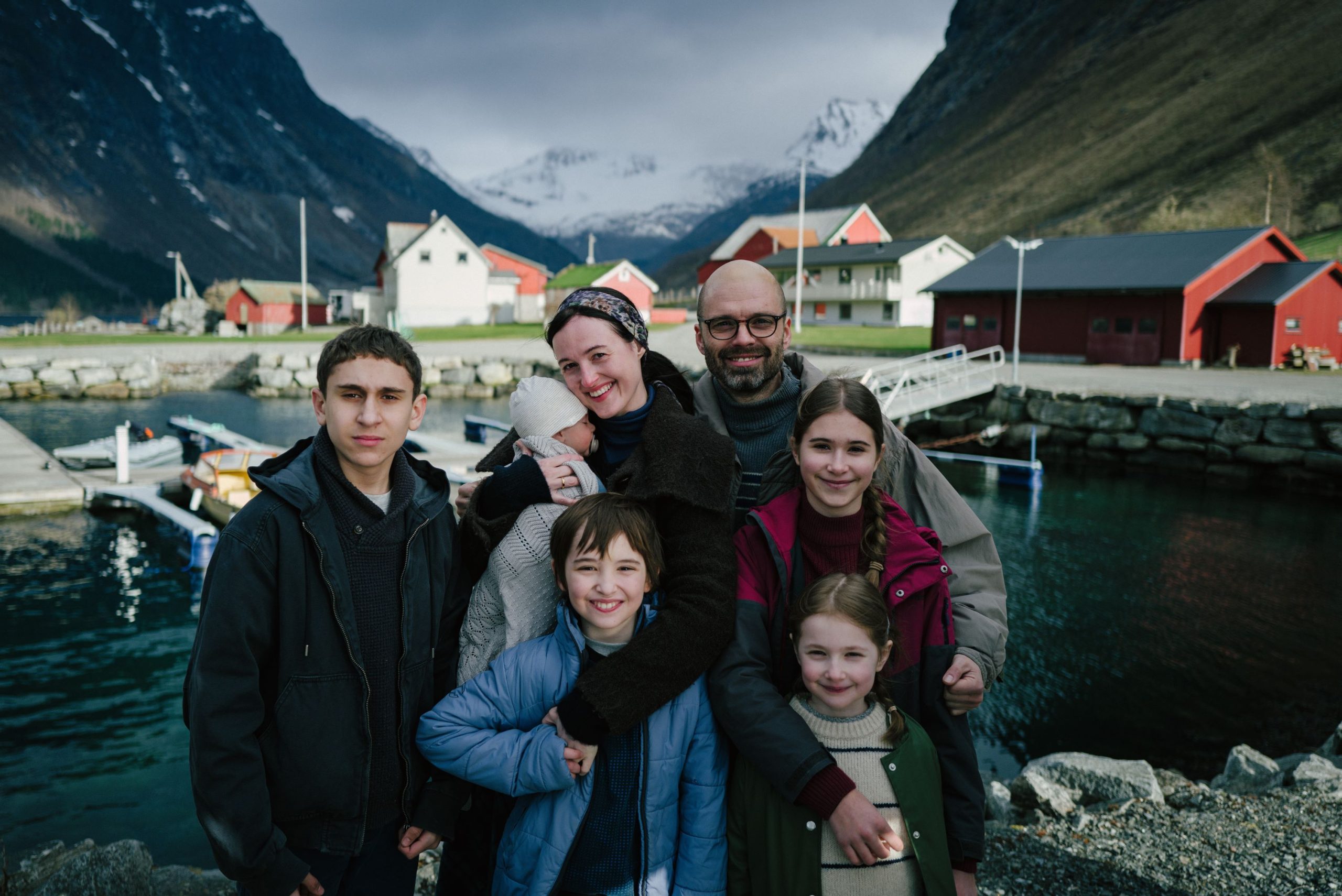
Once it won the Palme d’Or at Cannes, Fjord stopped being just a film. Between the movie and its audience, the prestige of the award inserted itself, along with the accompanying expectations, suspicions, claims, and demands.
In an interview given around the premiere, director Cristian Mungiu seemed to anticipate exactly this trap. Too many films today, he said, are made to confirm that the ideology of the day is the correct one—”And that’s not what cinema should do.”
After the Romanian screening, held simultaneously in 90 theatres across 52 cities, the film became the centre of an updated map of moral expectations that had first been put into circulation back in 2015, by the case of the Bodnariu family, whose children were taken by Norwegian authorities on suspicion of abuse.
Within film criticism, differences arose more from two interpretations of the same liberal tradition than from distinct ideological positions. Flavia Dima interpreted the film as “a rhetorical demonstration” rather than a genuine examination of the case that inspired it. Meanwhile, Andrei Gorzo saw it as an expression of consistent humanist liberalism, rejecting the caricature of Mungiu as someone who takes an “equidistant” approach to both sides of an argument.
Conservative voices were also present, though they were less likely to be film critics and more likely to be people claiming to see the political and religious reality behind the fiction. Marius Bodnariu praised Mungiu’s research, calling the film the result of a “thorough study”. In the Christian-conservative press, Fjord was seen as a belated vindication of the protests against Barnevernet, as well as a sign of suspicion towards Western institutional progressivism.
Political figures such as Ben-Oni Ardelean shifted the conversation towards state intervention in families and the rights of Romanian children. Titus Corlăţean, for his part, said he saw an unexpected defence of family and Christian identity in the film.
Mungiu himself knew what was coming. When asked by The Hollywood Reporter if he was afraid the film “could be embraced by right-wing groups claiming victimhood,” the director answered: “Absolutely. I think this is going to happen, but it’s a risk that I thought was worth taking in order to defend this right that we’re still having to doubt the values in which we believe, and also to speak about manipulation.” In doing so, Mungiu also revealed his own idea of what cinema should do.
The old enemy of art
The expectation that art should be politically engaged and reflect power structures and dominant ideologies has serious philosophical roots.
As leading thinkers of the Frankfurt School, Theodor Adorno and Walter Benjamin played a key role in shaping the relationship between art and ideology within the context of the culture industry. For them, a work of art could never be understood in isolation from the material and social conditions that produced it. No work was ever neutral; it either reproduced existing structures of domination or resisted them. The idea of art as an autonomous space, detached from politics, was, in their view, simply a convenient illusion for those who benefited from the status quo.
In the following decades, this idea gave rise to feminist aesthetics, postcolonial and decolonial theory, and the racial critique of art. Each of these has its own questions: Whose bodies are represented, and whose aren’t? What canons were built on exclusion? Who has the right to tell whose story? While these are legitimate questions that have produced valuable analysis, they have also led to the idea becoming embedded in broader culture that art is only relevant if it is conscious of its political position and willing to declare it.
The critics and audiences who received Fjord at its premiere largely grew up in a culture saturated with this expectation. So, it’s only natural that they would apply it. However, this school of thought is just the most recent in a long line of responses to the question, “What is art?” The other answers look fascinatingly different.
A history pocket
Formalism, which was dominant in the first half of the twentieth century, held that the value of a work of art lay entirely in its form, including its composition, rhythm, structure, and internal relations. A moral message or political context was considered irrelevant to aesthetic judgement. In other words, a work of art is considered good or bad based on its technical craftsmanship rather than its message.
Prior to formalism, expressive theories of art, articulated particularly by philosophers such as R. G. Collingwood, did not prioritise form or message, but rather expression. In this view, art is the way a person clarifies and communicates an inner experience that would otherwise remain unclear. Therefore, it is not what the work says or what the finished product looks like that determines its quality, but what it expresses and the authenticity of that expression. For Collingwood, a work that starts from a predetermined message and simply illustrates it is not art in the true sense.
If we go back further in time to the ancient philosophers, we find yet another approach. Art was simply meant to imitate reality. While Plato was suspicious of this imitation, seeing it as a copy of a copy that drew the soul further from truth, Aristotle rehabilitated it. He argued that poetry does not reproduce reality, but uncovers its inherent structure. He claimed that tragedy, through compassion and fear, produces a kind of purification, or catharsis, in the viewer which has value in itself, independent of any explicit moral lesson.
Thus, we see three very different views of art, none of which are purely contextual or dependent on the political position of the artist or audience.
Back to Fjord
When Mungiu described his film as something “designed to make you question your own opinions from time to time”, as well as a plea for empathy and the ability to question our own certainties, he knew that he wanted to elicit a particular response from viewers. However, he refused to dictate exactly what that response should be. He did not want the film to be seen as propaganda for one side or the other, but rather as part of a broader context: a story about dialogue fractured by cultural allegiances.
The distinction between planting the seed of an attitude and dictating a single correct position to the audience is a nuance that both critics and audiences ignored. The unanimous expectation was that Fjord should teach society a lesson. The only disagreement was over the content of that lesson. There’s a specialised term for art built around this expectation: “didacticism”.
The old temptation of useful art
The debate over the usefulness of art and the relationship between the work as an experience in itself and as a means of moral development has a long history. Even if nowadays the subject isn’t always framed in terms of the great aesthetic disputes, that doesn’t mean it’s been settled. It only means that certain assumptions have become so familiar that they now function as critical reflexes.
Plato was suspicious of poetry because he feared its ability to influence the development of a city by shaping the soul, intensifying emotions, and providing moral education. By contrast, the Roman poet Horace offered one of the most enduring justifications for useful art, arguing that poetry should both delight and instruct. Nineteenth-century aesthetes polemically pushed back against this tradition, defending the idea that art does not need to justify itself beyond itself and has no obligation to serve a moral, political, or didactic purpose.
While the history of aesthetics is not solely defined by this conflict, one of its persistent tensions concerns the clash between art as an autonomous form of experience and art as a tool for moral edification or correction.
Didacticism sits right at the centre of this conflict. In its basic sense, the term describes literature or art oriented towards instruction. In a more negative sense, it applies when instruction takes precedence over form, pleasure, and artistic complexity. It’s no coincidence that one of the most compelling arguments against didacticism today comes from the seemingly marginal field of children’s literature, a genre particularly susceptible to the temptation of turning fiction into pedagogy.
Without delving into the great aesthetic debates, American author Mac Barnett uses children’s literature as raw material to build a case against what he calls “always the enemy of good storytelling”, stirring controversy within the publishing industry in the process.
Barnett argues that didacticism judges a story by what it teaches children rather than what it allows them to imagine. In his view, a story that does not hesitate, leaves no room for interpretation, and stays out of touch with the messier textures of experience is art with a prefabricated moral. He even goes so far as to say that a story built as a vehicle for a moral isn’t really a story at all. Barnett believes that the dishonesty of such a work lies in the fact that, once built around a message, it must strip its characters of anything that might complicate that message—the contradictions and ambiguities that accompany real human beings, but which would distract from the moral of a story with a lesson attached. While what’s left after this cleansing process is certainly easier to understand, it is also, without question, far less artistic.
Radical honestly about what it means to be human
So, should we ask art to abandon all moral content? This would be impossible since human beings are moral creatures by nature. Or should we defend aesthetic freedom without any limits? This would lead us straight into an endless loop of relativism.
A more legitimate objection to didacticism is the refusal to replace moral complexity with a sterile, pre-packaged conclusion. We can observe this principle in the professional ethics of Flannery O’Connor, one of the most widely read American authors of the twentieth century.
O’Connor wrote that “fiction is about everything human and we are made out of dust”. She added that anyone who’s afraid of getting dusty should not write fiction. This statement is all the more striking coming from a religious author and practising Catholic. O’Connor had no intention of advocating artistic libertinism. On the contrary, her convictions pushed her towards radical honesty about what a human being actually is: a creature full of shadows and inner dissonance, carrying real guilt and real hope. This is why O’Connor believed that art which removes the wolf from the story in order to save everyone—art that sanitises reality of its complexity—would actually fail to achieve its edifying purpose. Instead, it would produce fragile souls: people who had been consistently shielded from darkness and raised in controlled conditions, who would be crushed by their first real contact with evil.
The psychologist Bruno Bettelheim came to a similar conclusion from a secular perspective in The Uses of Enchantment: The Meaning and Importance of Fairy Tales, defending classic fairy tales against a sanitising pedagogy that sought to rewrite them without wolves or ogres. Children can handle the tales without experiencing trauma, he argued, because the fears and rages already exist inside them, just without a name or a shape. The fairy tale lends these fears and rages a face, and with that face comes a boundary. When children hear about the ogre, they discover that their fear can be named, and that which can be named can also be defeated. Healing comes from confronting the shadow in a safe environment, cradled in the arms of someone who continues to read.
However, one caveat is that, for Bettelheim, classic fairy tales mainly work psychologically for children who can already understand the symbolic conventions of the stories. “Once upon a time” is not “happening right now in my room”. He notes that fairy tales really start to make sense around the age of five, since by then the typical child no longer mistakes them for the real world. More caution is needed for very young children, especially those aged two to four. The Canadian Paediatric Society notes that, at this age, imagination is extremely vivid and children can have great difficulty separating reality from fantasy. Therefore, while an ogre might help a six or seven year old to confront their fears, it could overwhelm a three year old, particularly at bedtime. A child who can already symbolically live inside a story is protected precisely because they encounter the antagonist in narrative form: bounded and accompanied.
So, while O’Connor demanded this in the name of a theological vision of evil and grace, Bettelheim argued for it in psychoanalytic terms. A story stripped of darkness risks losing the very thing that enables a child to confront their fears in a symbolic and manageable way.
Didacticism or legalism?
We have seen that didacticism begins with the admirable intention of defending and promoting the good, protecting it not only from evil, but from ambiguity, too. However, it is precisely this haste to protect the good that drains it of vitality. The problem with didacticism is that it tries to change a person just by teaching them, and so it sanitises its messages until they become completely sterile. However, sterile also means infertile.
Christian theology is well aware of the powerlessness of moral forms to transform the heart. In religious terms, didacticism is the equivalent of legalism, which recognises the ideal, but cannot produce real love for it in a person. It may generate certain behaviours to a greater or lesser degree, but it cannot facilitate freedom in Christ. Similarly, didactic art can tell its audience what to believe, but it cannot lead them deep enough to recognise truth personally. This is why the author’s intention matters less than we think. What matters more is whether the author treats the readers the way an impatient teacher would, or offers a story in which the readers can see themselves.
The parables of Christ are probably the earliest example of this type of teaching with which Christians are familiar. Parables were Christ’s usual way of speaking to the crowds, even though he had the entire Law and the Prophets at His disposal, along with the full argumentative apparatus of the rabbinic schools. Instead, He chose the story, which, through its familiarity and unhurried pace, creates a safe space in which a person can see their own soul reflected and allow their mind to be changed.
Christ delivered His parables without spelling out an explicit moral. He told the story, planting it in people’s souls and letting it take root at each person’s own pace. Even two thousand years after they were first heard, listeners still find them revealing and full of meaning. This method compresses an entire anthropology, based on the conviction that human beings understand themselves through stories long before they can articulate their identity in words.
“You are the man!”
The Old Testament contains many such gems. One of the best known is the episode in which the prophet Nathan confronts King David with his hidden sins: David had committed adultery and murder. The prophet had to awaken a conscience that had become complacent, believing that what he had done was inevitable, perhaps even necessary.
Nathan chooses the path of storytelling, sidestepping the defences David might have used to justify himself. He tells David a story about a rich man, a poor man, and a little ewe lamb, and the deep injustice that bound them all together. When David’s heart is stirred by outrage at the injustice in the story, the prophet reveals the truth: “You are the man.” David understood in a way that he never would have if he had been accused directly. His mind would not have been convinced by rational argument, but the story presented the most convincing argument of all, based on a truth that could no longer be denied.
Did Nathan lack logical arguments, or the rhetorical skill to deliver them persuasively? This is hard to believe. But he chose something else instead, convinced that the human heart opens to narrative before it opens to logic.
Feeling with other hearts
C. S. Lewis took a similar approach in An Experiment in Criticism, describing reading as a desire to see with other people’s eyes, to feel with other people’s hearts, and to live, if only for the length of a book, lives other than our own. This is why Lewis said that, when reading great works, he became a thousand different men yet remained himself.
This expansion of the soul is more than a simple psychological exercise: it is a genuine training ground for loving one’s neighbour. Through fiction, a person can develop the ability to see beyond their own point of view, understand unfamiliar emotions, and imagine experiences outside their own life.
The truth witnessed by beauty
We need stories, and the reasons for this extend far beyond mere entertainment. In fact, they seem almost as layered as the reasons behind our need for air itself.
In his essay, “On Fairy-Stories”, J.R.R. Tolkien wrote that human beings create stories because they themselves were made in the image of a Creator. Even though we cannot create out of nothing—which is why Tolkien called us “sub-creation”—our need to give shape, to build worlds, and to tell stories is written into our very nature as beings made in the image of God.
But does this mean that God made us for escapism? Did He give us an appetite for fleeing the difficulties of life or ourselves? No. Tolkien doesn’t reject “escape” as such, quite the opposite, in fact. He defends it as long as it is the escape of the prisoner and not the flight of the deserter. Only a false story can become a false refuge or a form of delirium. A well-crafted story, grounded in truth, has the opposite effect: it enables us to return to reality with a fresh perspective.
In the same essay, Tolkien coined the term “eucatastrophe”: a good turn of events, the moment when, though everything seems lost, joy unexpectedly arrives. The great eagles arrive; the stone is rolled away. Tolkien argued that this moment is present in all the great stories of humankind and is an echo of the Resurrection built into the very structure of human storytelling. It is a sign that our imagination was shaped by an Author who wrote such a turn of events into real history.
Great stories do not lie by promising that everything will end well without loss. Tolkien had learned this lesson himself in the trenches of the Somme, so he allowed himself no such naivety. However, great stories always hold open the possibility that good can triumph over evil. Holding that door open against every force pushing the other way is itself a form of Christian witness.
If it’s bad art…
Stories bear witness to truth by demonstrating its beauty. Hans Urs von Balthasar built an entire theology around this idea. Beauty is a fundamental attribute of divinity, and one way in which God reveals Himself.
Consequently, a theology that treats aesthetics as superfluous embellishment results in a loss of clarity regarding the image of God, tempting us to pursue clarity through austerity.
At the other extreme, when we force art to submit to an agenda, even a noble one, we risk causing it to lose its truth. Sincerity alone is not enough for a mission as vast as expressing what it means to be human in the world. Even honest, well-intentioned art can betray itself and become false through carelessness, sentimentality, or the assumption that piety can compensate for poor execution.
Madeleine L’Engle expresses this idea forcefully in Walking on Water: “If it’s bad art, it’s bad religion”, she writes, “no matter how pious the subject”. A Christ depicted as sweet, tame, and harmless can actually be further from faith than a secular painting, since the latter does not claim to convey anything about the divine.
Therefore, form can counterfeit truth even while claiming to serve it. This is because form is part of how truth becomes perceptible.
Whose side are you on?
Despite all the tension it stirred up, Fjord enters into a conversation about usefulness as a symptom of a culture that keeps summoning art for questioning: Whose side are you on? Who are you condemning? What are you validating? These are good questions, but they narrow our perspective when our entire encounter with a work of art is reduced to them.
Art is a form of communication that we can only grasp if we are willing to understand the other person. Otherwise, just as we reject, refuse to dialogue with, label, judge, and instrumentalise one another, we end up doing the same thing to art. A more liberating approach is to stop defending some notion of pure art, as if it could exist above history, whether the grand sweep of it or the small, personal history of its creator. No such art exists. Every work emerges from a biography and a philosophy of life and is expressed in a particular language that, by its very nature, gives it direction. We may set out to reject ideology, but this rejection itself is a kind of ideological position.
And yet, even though art carries a certain worldview that it can never fully shed due to the way it is constructed, it remains art as long as it respects its audience and does not manipulate or dictate to them.
Rather than aiming for perfect—and illusory—neutrality, art’s real task is to remain faithful to the complexity of reality. It’s a subtle difference, but we all recognise it when we realise that the stories we love most are the ones that allow us to continually discover new shades of meaning that grow in intensity and renew themselves along with us.