
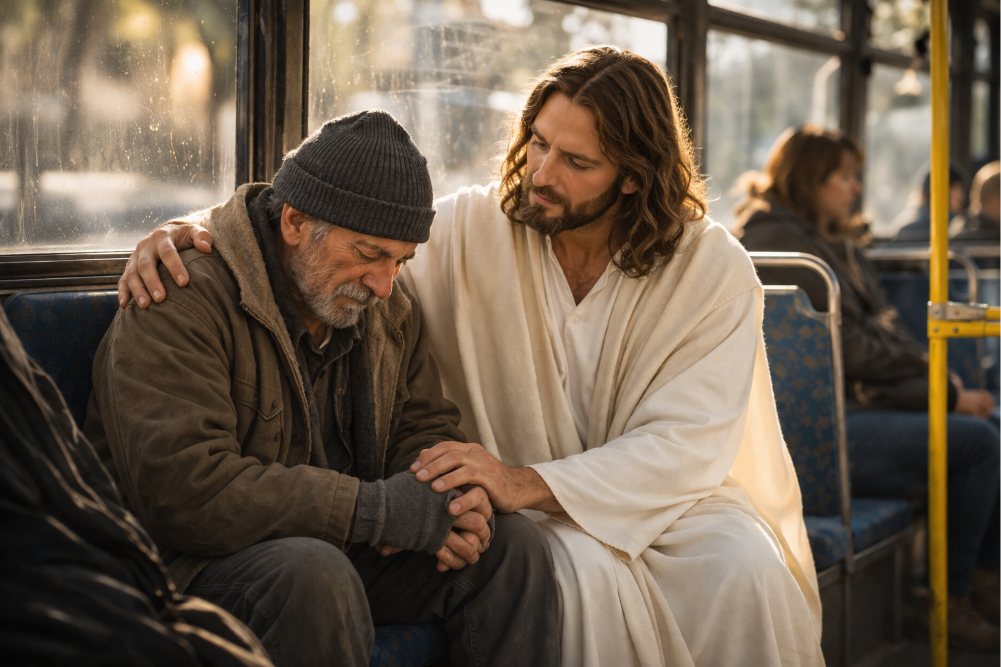
We are generally surrounded by people close to us—family, friends, or colleagues. We build a kind of microcosm in which we stand at the center, alongside the relationships we choose to maintain. But on that particular day, I was reminded that everyone has their own microcosm.
Most of the time, I travel by car—either alone with my own thoughts and concerns or accompanied by one or two familiar faces. It is a closed circle. But that day, I boarded a bus through the middle door and leaned against a rail from where I could clearly observe the other passengers.
I noticed two elderly women engaged in an animated conversation, teenagers just out of school carrying that familiar mix of indifference and youthful euphoria, and a man sitting alone across a row of seats, staring out the window with a distant gaze. People I will likely never see again, with whom I will never have any connection.
In the marathon of life, it is easy to forget that there is a world beyond our own. It is easy to become absorbed in our personal struggles and fail to realise that the person next to us may be going through the very same things. Dense cities and a fast-paced rhythm of life gradually erode the very element that underpins human connection: empathy. In its absence, what remains is a modern adaptation of the law of the jungle, where self-interest prevails.
Learning empathy from its Master
Love for one’s fellow human being is one of the central pillars of Christian ethics, and the life of Jesus serves as a guide in this regard. His entire ministry was devoted to meeting the physical and spiritual needs of those around Him. A striking example of empathy is found in a verse that has long fascinated me—John 11:35: “Jesus wept.”
What has always stood out to me in the account of Lazarus’s death is precisely this: that Jesus wept. The loss of a close friend is, of course, painful, yet Jesus knew that Lazarus would be raised again. From a rational standpoint, His tears seem unnecessary. But here, reason is transcended, and what we see instead is a heart overflowing with love and empathy for those who suffer—an outpouring that could not be restrained. Jesus, a Being who surpasses our capacity to comprehend, weeps for a man who, in the vastness of the cosmos, might seem no more than a speck of dust.
Let us assume, however, that this involved a circle of familiar people and that we might respond in the same way under similar circumstances. On another occasion (Luke 19:41–44), Jesus wept over Jerusalem—a city inhabited by many kinds of people: some who appreciated Him, some who criticised Him, some who would later press for His crucifixion, and, of course, many He had never met. He wept for the tragic future that awaited the city after His death and ascension.
For us, tragedies often become mere statistics. I was not overwhelmed with grief for the 400 people who died in the bombings in Gaza on March 18, 2025. Many of them were eating before sunrise, in keeping with a tradition observed during the month of Ramadan. Entire families were almost instantly wiped out as a result of a broader conflict. When we are not directly involved, we have grown accustomed to viewing the rest of the world with a certain indifference.
The ultimate example of empathy remains the incarnation of Jesus. He relinquished His heavenly glory to take on the worn and fleeting garment of humanity; He chose to suffer alongside us so that we might be given the chance of a renewed life, the chance of salvation. He was mocked, betrayed, and abandoned by those closest to Him, and He endured a painful death. He chose to step into the pit we are in, in order to lift us out of the abyss of sin.
When I was a child, someone close to me called an ambulance for a serious medical emergency. Later, she recounted the experience, emphasising how deeply the ride in the ambulance and the uncertainty of survival had affected her. In the end, she told us that every time she sees a siren-lit vehicle speeding down the street, she offers a brief prayer for the one who is suffering. It can be difficult or uncomfortable to look beyond our own microcosm, and at times we become so absorbed in it that we forget this is even possible. Yet we are given opportunities to build our empathy step by step by looking to the flawless example of our Saviour. Perhaps what humanity needs most today is a warm smile and a helping hand extended to the “least” among our brothers—who are, in fact, His brothers as well.
Codrin Panainte seeks empathy at its source, following in the footsteps of Jesus to uncover examples of His care and compassion for those afflicted by suffering.