
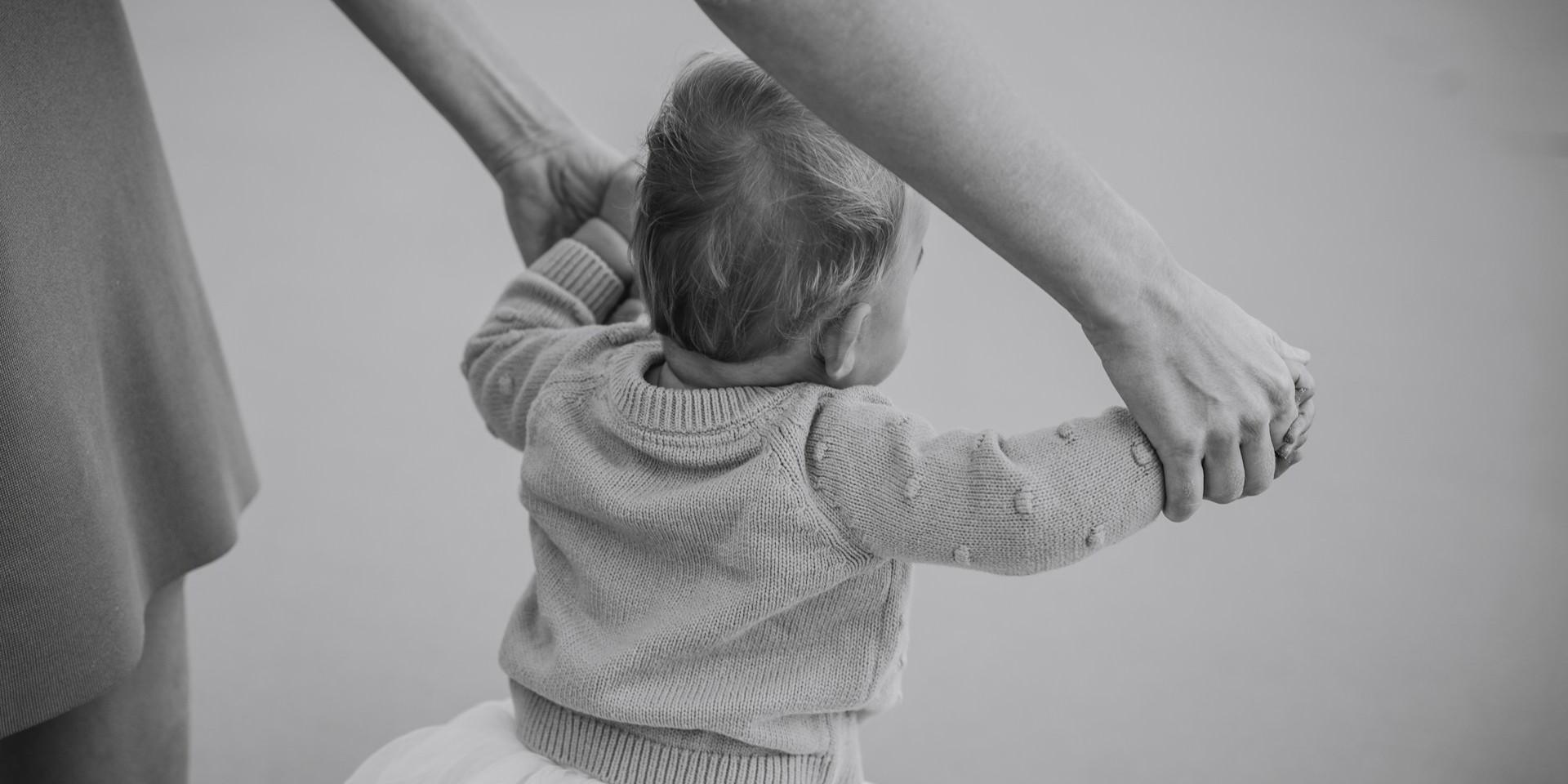
I was standing in the supermarket queue, pushing my daughter in her pushchair, when a man well past his prime wearing camouflage trousers gave her a long look. Then he turned to me, as if continuing a conversation about parenting we’d started long ago, and said, “You know, this little girl is going to heal a lot of things in you.”
Maternal-fetal microchimerism is a phenomenon in which a small number of cells from the foetus cross the placental barrier during pregnancy and enter the mother’s bloodstream. These cells can survive in the mother’s body for years, and although the subject is still being actively researched, some studies suggest that microchimeric cells may play a role in healing organs after injury or illness.
However, I knew for certain that the man in the shop had not meant that kind of healing. The healing I had already become aware of was related not only to how I relate to life, but also to how I relate to God.
Parenting and trusting God: “If she’s cheerful and gaining weight . . .”
One of the first healing lessons my daughter taught me was that uncertainty is part of life and that resisting it only causes unease. At first, I found this hard to accept. Whenever I tried to ensure her health, I was surprised to hear the same response from doctors and experienced mothers alike: “If she’s cheerful, eating well, and gaining weight, then she’s fine.” I found this simplicity unsettling, until I realised I was missing something essential. I had never before experienced the joy of watching a tiny human grow and thrive on nothing but food and affection. Before my eyes, I saw God’s hand sustaining and blessing life.
Although my daughter seemed completely dependent on me, in reality she was receiving everything from God. I did not understand what was happening in her fragile little body; I simply watched in wonder as she developed. It was then that I realised that we adults also often live under the illusion of control. We think we are masters of our own lives, but deep down, we are just as dependent on God and just as vulnerable in the face of the unknown as babies, who can do nothing but entrust themselves completely to the One who cares for them.
Separation anxiety and the lesson of trusting God
As my daughter grew, I watched in amazement as she acquired new skills, one step at a time, each one natural to her stage of development. She began to recognise the faces of her loved ones, and mine quickly became her point of reference. Soon, however, came the moment when she realised that Mummy could leave the room. This discovery brought with it an intense fear and whenever I disappeared from her sight, she would burst into inconsolable tears. Specialists explain this separation anxiety by the fact that a child cannot yet grasp, cognitively, that a loved one continues to exist when they are not beside them. To the child, Mummy’s disappearance is akin to losing her forever.
There is a powerful parallel between this stage of development and the life of faith we lead. As fallen beings, we are separated from the visible presence of our Creator, God. For many of us, this separation causes pain similar to that experienced by a child separated from their mother when they are still too young to understand that she has not disappeared forever, just temporarily. Just as a child matures and develops the capacity to understand that their mother will return, so a Christian matures and develops the capacity to believe that God exists even when we cannot see Him, and that He loves us and cares for us even when He does not seem to be beside us physically. A touching verse from Isaiah supports this analogy: “Can a mother forget the baby at her breast, and have no compassion for the child she has borne? Though she may forget, I will not forget you!” (Isaiah 49:15)
Why children need healthy boundaries
Time passed, and the child evolved from an observer to an explorer. However, in her eagerness, fuelled by her wonder at the world and all its sensations, she does not realise that it also holds risks and dangers. It is my job as a parent to set healthy boundaries within which my child can explore safely. Just as a child may feel constrained by a parent’s boundaries, I, as an immature Christian, may also feel that God’s law is too restrictive and keeps me from enjoying life to the full, without fully realising the dangers I would expose myself to if I explored without boundaries.
Just as the boundaries and rules a parent sets help a child truly enjoy their freedom, God’s Law gives us the structure of character we need to function at our full potential as human beings. Maria Montessori, the educator, is said to have remarked that allowing a child to do whatever they want before they have developed any self-control is a betrayal of the idea of freedom. Similarly, divine law protects us from the false freedoms we or others impose on ourselves and helps us to truly enjoy the beauty of life.
Connection, not conformity: the parent-child relationship
Of course, accepting restrictions does not come naturally to us, particularly when we cannot grasp their purpose. We see this reaction in children and adults alike, and the parallel with the life of faith is clear. A parent shows empathy towards a child who is suffering because of a boundary, yet maintains it. Similarly, God stays with the person who is suffering, yet maintains His standard. This is because, just as a parent’s aim should be, God’s aim is not to obtain blind obedience from the believer, but to build such a solid relationship that His child will listen to Him even when they do not understand.
How is this understanding obtained? By cultivating trust in the wisdom and benevolence of our heavenly Father. When we are convinced that God knows better than we do and that He wants what is best for us, we can tolerate the discomfort of having our plans refused or cancelled. Similarly, when a child has a healthy attachment to their parent and the parent models respect for others (children or adults alike) the child becomes convinced that they can trust their parents, even when they dislike the direction in which they are being led.
The adult’s responsibility: regulating the child’s emotions
In the early years, while the prefrontal cortex (the part of the brain responsible for rational decision-making) is still developing, parents must form a strong bond with their child, essentially becoming a kind of co-brain and helping them to manage frustration, upset, and overwhelming emotions.
No parent expects their child to behave perfectly. Tumbles, mistakes, and frustrations are all part of the natural learning process. Just as they are not alarmed when a child falls several times while learning to walk, a wise parent sees a mistake as part of progress, not the end of the road.
But what happens when a child deliberately misbehaves, or when their actions begin to damage their relationship with their parent? It is here that we can look to God as an example of how He educates us, His children.
We seek God because He sought us first. We love Him because, as Scripture says, “God demonstrates his own love for us in this: While we were still sinners, Christ died for us” (Romans 5:8). The more emotionally mature person takes the first step.
Similarly, a parent is called to gently seek out their child, help them understand where they went wrong, and show them how to put it right. We cannot expect a child to realise their mistake on their own. We need to guide them with patience, love, and initiative.
Forgiveness in parenting and unconditional love
The most precious lesson I have learned from raising a child, and the one that has brought me the greatest healing, is the importance of forgiveness.
A parent’s love covers almost any mistake their child makes because it is complete and unconditional. Discovering this capacity in my own heart, however imperfectly, gave me the courage to believe that God loves us in the same way, but perfectly.
A child makes mistakes in many ways, and the parent forgives. Not to ease their own conscience, but by accepting the loss, whether a broken vase or a harsh word, without seeking revenge or validation. This forgiveness, received from God, must be passed on to those around us and to ourselves.
We love imperfectly. Sometimes, we indulge instead of loving, and at other times, we cause harm in our attempts to combine affection with discipline. Forgiveness is the solution: it means acknowledging the mistake and trying again.
As a parent, you become an expert at starting over, as Scripture says, “Though the righteous fall seven times, they rise again” (Proverbs 24:16). The hope that pushes us to try again is itself a sign of healing.