
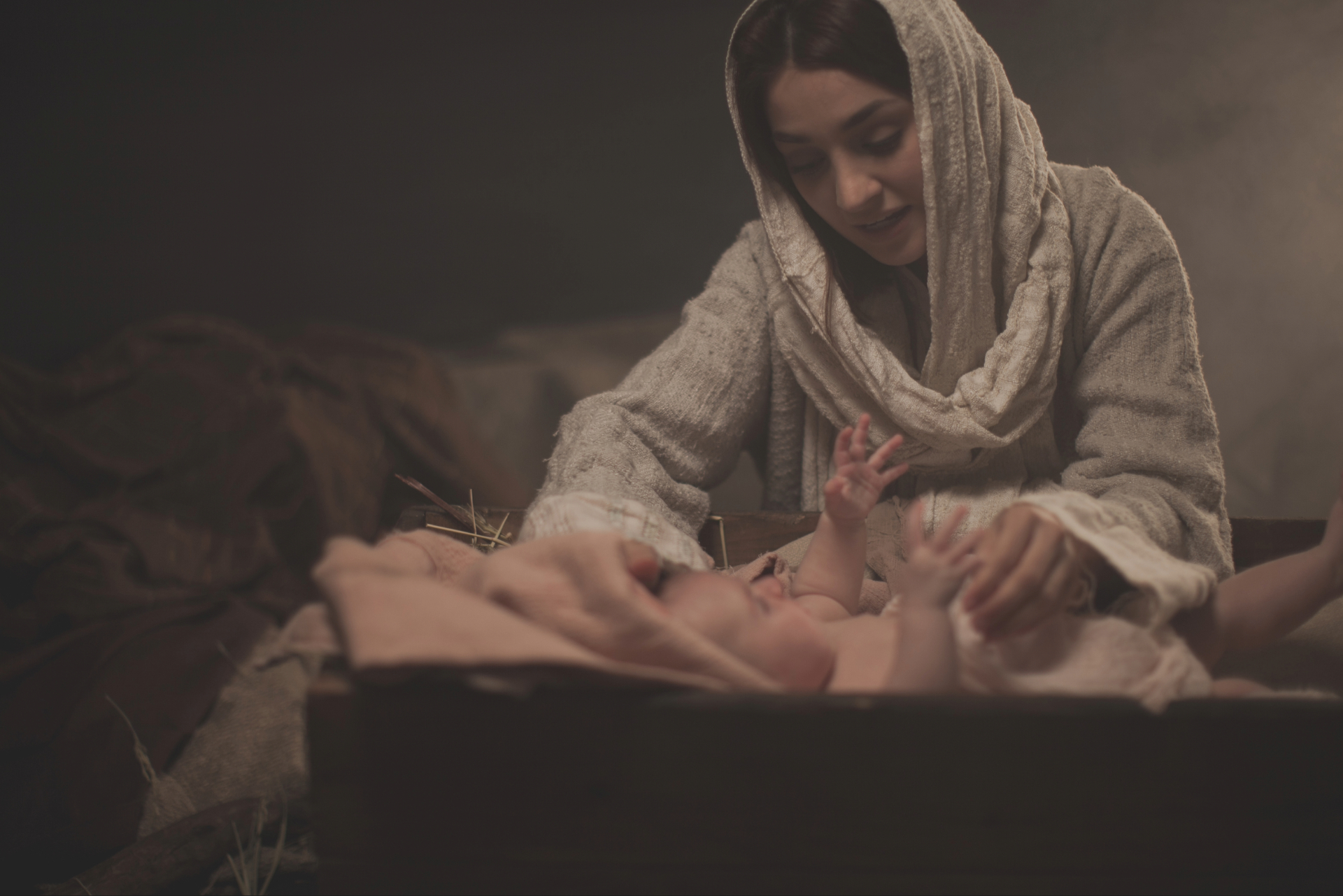
Mary was an ordinary person, just like us. The Gospel does not suggest that she had any particular merit, yet her obedience played a pivotal role in a story that would change the world.
When the angel Gabriel announced the news to her, he greeted her calling her the one who is “highly favoured” (Luke 1:28)—in other words, she was shown mercy and benevolence by God, who indulged her.
The angel offered the customary heavenly greeting: “The Lord is with you,” to which later manuscripts add another greeting taken from Elizabeth’s song (verse 42): “Blessed are you among women!”, reminiscent of Deborah’s song in honour of the heroine Jael (Judges 5:24).
Mary was not the only virgin in Nazareth, nor the only girl among the descendants of David, nor the only pious virgin. However, Gabriel announced that God had chosen her to be the mother of the Saviour of the world. She did not expect such an honour from heaven—an honour that no one else had ever received, nor would ever receive again. However, when God honours you, be prepared to endure the mockery of the world!
Mary responded humbly: “I am the Lord’s servant. May your word to me be fulfilled” (Luke 1:38). Her response seems to have been uncalculated. She had learned not to negotiate with God about His plans. “Thy will be done” was her prayer before she learned the Lord’s Prayer.
Difficult decisions
The memory of another acceptance was still fresh in her heart. Although we don’t know her exact age, we do know that she was already engaged to a craftsman named Joseph, who was also a descendant of the impoverished line of David. In those days, girls married young. However, the man to whom Mary had tied her fate was not a bachelor, but a widower with four sons and at least two daughters (Mark 6:3). Not every girl would have agreed to take on the role of wife to a man 15–20 years her senior and become the mother of seven children of different ages, all of whom needed love, care, and education. It was not easy at all.
According to custom, Joseph had asked Mary’s father for her hand in marriage, and her father had asked her, as was customary, “Will you go with this man?” “I will go” (cf. Genesis 24:58). According to the law of the time, Mary was legally married to Joseph, although she continued to live with her parents until the wedding. As if Joseph’s house were not already full, it is announced that another baby is on the way. This time, it would be hers.
The situation was far from simple. What would Joseph do? What would her parents and the whole world say if they found out that the baby wasn’t his? According to the law, an unfaithful fiancée was to be treated like an unfaithful wife and stoned to death alongside her lover (Deuteronomy 22:23–24). In Mary’s case, however, the lover was missing. The law could not condemn her alone. One might assume that she had been raped. However, it was not so much the law itself that was frightening, but rather the people who enforced it (cf. John 8:4–5). In such a case, a miraculous explanation would have been embarrassing. Perhaps, Joseph would have believed her anyway. Even if he did not, she would submit to God’s will, knowing that He would take care of them.
According to the Gospel, Joseph could not accept her story about the baby who came from above. Perhaps we would have drawn his attention to Isaiah’s prophecy (7:14) that “the virgin will conceive and give birth to a son,” but the word “virgin” does not appear in the original Hebrew text, only in the Greek translation. After much thought, Joseph decided that, for the safety of his family, it would be better to give Mary up before the wedding, leaving her secretly in the care of her parents as though he had changed his mind for no reason and choosing not to file a legal complaint against her.
According to the Gospel, Joseph was informed in a dream by an angel that Mary was innocent and sincere. Joseph therefore took Mary as his bride and took her under his protection. However, he would not consummate the marriage until after Mary had given birth and the forty days of purification had passed, as required by law (Matthew 1:24–25; Luke 2:22–24).
Other trials, the same grace
The birth of Jesus was not easy for Mary or Joseph, however. A Roman census had been ordered and, since they were both from the city of David (Bethlehem), they had to leave their grown-up children in the care of their grandparents and travel 140 kilometres on donkeys, stopping frequently, for almost a week.
When they arrived at their destination, probably during the autumn holidays about four years before the start of the Christian era and while Herod the Great was still alive, they were surprised to find that there was no room for them at the inn. Mary, in her final month of pregnancy, was ready to give birth. Someone, perhaps a relative, took pity on them, knowing they were in need. They were put up in the stable, which was usually on the ground floor of the house. So, Mary gave birth to the King of Heaven in the shelter of animals and, instead of a cradle or crib, laid Him in a manger.
But, God’s help was not long in coming. All sorts of amazing things happened to them. Some shepherds came to visit, saying that an angel had sent them to see the Messiah. They brought what they could: cream, cheese, and milk. Some wise men from faraway lands travelled for a month to find the great King of the Jews who had just been born, coming from nearly 1,000 km away from the countries of the East. They brought valuable gifts, which would be very helpful on their next journey. Joseph had just been informed by an angel to flee to Egypt with Mary and the Holy Child, who were being sought by Herod’s soldiers. However, a few months later, in the spring, Herod died and Joseph, Mary, and the child returned to their homeland of Nazareth.
Scripture does not urge anyone to honour the image of the Mother of God, but rather to honour her memory by following the same path of trusting in God despite the risks involved. Just like with Mary, who became a wife, mother, nurse, cook, laundress, and teacher, accepting God’s will alongside your existing difficulties could be risky and very stressful. But God is always there, ready to help in ways only He knows. Are you ready to accept the good news that God has sent you (Luke 11:27–28; John 2:5)?
Florin Laiu sees in Mary not a distant icon, but a devout young woman who accepted God’s call without asking for guarantees. Her complete obedience and courage in the face of shame and danger remain a benchmark for anyone learning to say “Thy will be done!”