
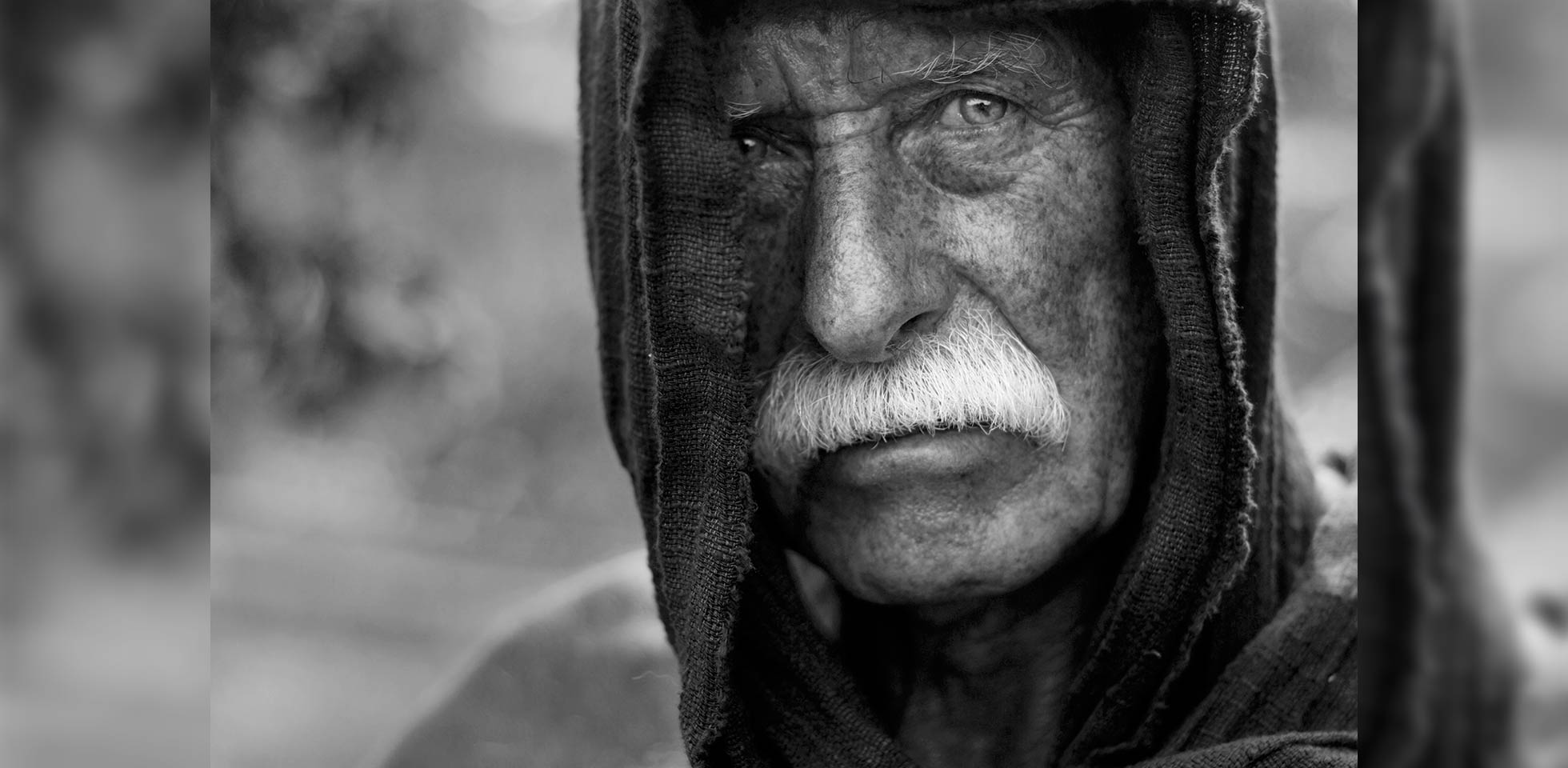
There are people who love animals; we see them often, offering scraps of food to stray dogs or pigeons in public squares and parks, gazing at them affectionately, touching them, speaking to them tenderly. Rarely, however, does any of that reserve of sympathy find its way into the silence, indifference, or reproach with which people respond to a request for help from someone stripped of hope, home, and future, yet still burdened by the remnants of a life in which they were never the central character—not even for someone dear to them.
In 2014, 26-year-old Cătălin Ciuculescu from Timișoara, Romania undertook a courageous journey of the kind that continues long after the traveler has returned home. The journey lasted four days and—more importantly—four nights, placing him in an unfamiliar setting and an entirely new role, one that required the temporary surrender of every comfort. For a short time, Cătălin chose to live as a homeless man.
“For I was hungry and you gave me something to eat, I was thirsty and you gave me something to drink, I was a stranger and you invited me in” (Matthew 25:35).
And so, he prepared to step into character. His new identity required a different appearance: he grew a beard, cut his hair short and unevenly, dressed in worn clothes, carried a raffia bag filled with several copies of the New Testament, and took along a thin jacket to use as a blanket. Missing from his inventory were his phone, identification papers, and money. He carried only 5 lei for emergencies.
At first, he was accompanied by a friend, Bir, 22, from whom he parted ways at an intersection; each would experience separately the unknown realities of life on the streets. The cold proved too discouraging, and Bir abandoned the project after one day and one night outdoors.
The coordinates of a new identity
Having something to eat for lunch and finding a place to sleep become the priorities of each day. Cătălin secures his food from the money he receives throughout the day. Once a week, he eats what “converted people” bring him, and much of the time he relies on the generosity of other homeless people.
They prove friendly toward the newcomer, willing to lend a helping hand to “people like them,” even when that means dividing a single processed cheese cube into three portions. Gratitude and generosity are not absent from the emotional economy of those who have lost everything. From the small amount of money he receives on the street or from acquaintances he happens to meet—people who discover his project with surprise—he shares some with Ion, a man who has been living on the streets for 25 years.
The modest sum seems permanently lost when it becomes clear that Ion has taken the little treasure to the nearest bar. Yet the container of pumpkin pie he later brings for his benefactor’s dinner stands as living proof that generosity can still dwell in a soul crushed by addiction.
A full night’s sleep is an unattainable luxury. The cold that settles in with the approach of winter—reddening the eyes and roughening the voice—eliminates options that would have been available during the warmer season. The park and its welcoming benches can shelter Cătălin only during the daytime. So, he finds himself hoping for a few hours of sleep inside the train station, as many of these wanderers do. But during the night, security guards inspect the waiting area, separating travelers from intruders, and anyone without a ticket is escorted out.
Cătălin realizes that he experiences time differently than in the days governed by schedules and the comfort of a refuge called “home.” “When you live on the streets, time moves slowly. You have no reason to hurry; no one is waiting for you…”
One essential human need—rarely fulfilled in the lives of homeless people—is the need to know that you still belong to a community. The need not to exhaust every personal relationship. The need to be treated as a human being despite all that has been lost.
Losing one’s home is only the first step in an experience that quickly gathers momentum. It may be followed by the loss of a job, the depletion of financial resources, the breakdown of family and friendships, fractured ties with the community, deteriorating health, and the onset—or worsening—of addiction to alcohol or other substances.
The identity of someone uprooted from the stabilising reality called “home” gradually fragments into pieces that can no longer be put back together. The person begins to resemble the famous Slinky toy: able to go down the stairs, but no longer capable of climbing back up.
From the very first minutes of his experiment, Cătălin Ciuculescu received a message that long ago ceased to be cryptic for people who truly live on the streets: to passersby, they are invisible. The indifference of others is unmistakably written in every vacant glance, eyes that almost never meet those of a person disarmed by life. The awareness that his newly assumed status placed him, in the perception of others, somewhere on a continuum between a human being and a stray dog even began to shape his posture into one of humiliation. “I walk down the street and I can’t bring myself to lift my eyes from the ground. When you’re poorly dressed, you feel inferior. I’ve only been homeless for a few minutes, and already it feels crushing.”
Perhaps the saddest interactions were those between the pretend homeless man and the members of the Christian churches he visited. Although his expectations were modest—limited to the basic human interaction implied by a greeting—some experiences proved deeply disappointing. The grandeur of the Gospel message being preached failed to extend horizontally into relationships with a disadvantaged fellow human being. People were not interested in learning his name, hearing his story, or, even less so, understanding his needs. It seemed that a homeless person did not qualify to be recognised as “the least of these brothers of mine.” There were exceptions. In one church, he was invited to sit in the front row because it was warmer there, and after the service people asked who he was, where he came from, and where he slept. Whenever he was treated kindly, the young man revealed his true identity and the purpose of his project: to better understand the life of a homeless person by experiencing their pain and anxieties firsthand.
The conclusion of those four days was that people on the streets live in an ocean of bitterness that most of us cannot understand because we have never tasted even a drop of it. We still have hope, but that notion has disappeared from both the vocabulary and the lived reality of those without a home—just like the word “home” itself.
The scale and perception of a phenomenon
Cătălin Ciuculescu’s experience does not meet the standards of a sociological or psychological study. It includes no research methodology, follows no epistemological framework, and, of course, carries no academic authority. Nor does it conform to the expectations of a literary work. Yet it possesses another kind of virtue: it moves us enough to look a homeless person in the eye, to restore to them the attributes of a human being, and to care about them. Because, the young man assures us, when you truly care about someone, you also know how to help.
An organisation that works with homeless families challenges several myths surrounding this disadvantaged group. One of those myths is the belief that they are personally to blame for losing their homes. In reality, this is a highly heterogeneous group, spanning all age categories—from children to the elderly—and encompassing a wide range of personal trajectories. A 2004 study found that, in terms of educational background, homeless people in Bucharest, Romania were distributed as follows: 8% had no formal education, 24% had primary education, 60% had completed secondary education, and 8% held higher education degrees. Homelessness is typically caused by a combination of internal and external factors. While personal choices may contribute to the loss of housing, external circumstances also shape those choices. In theory, anyone could end up in such a situation, especially in the absence of support from family or friends who could provide shelter and help address the problems that led to homelessness. Divorce, domestic violence, unemployment, or the restitution of formerly nationalised homes are just some of the reasons a person may end up on the streets.
Finding employment could be part of the solution, but the lack of clean clothes, poor hygiene conditions, the absence of a permanent address or phone number, and limited education all become major obstacles to securing a job.
In Romania, there are no national strategies for collecting data on this vulnerable group. A 2004 study conducted by the Research Institute for Quality of Life estimated the number of homeless people in Romania at between 14,000 and 15,000, nearly 5,000 of whom were living in the capital.
In 2010, estimates regarding the number of people living on the streets of Bucharest remained relatively unchanged, though this does not mean the scale of the problem had diminished. While several hundred people die each year, others who fall into difficult circumstances take their place. The number of beds available in the capital’s night shelters barely exceeded 300 back then—a wholly inadequate capacity for the thousands of people without homes.
One myth that discourages any attempt to provide help is the belief that there will always be homeless people, that homelessness is an unsolvable and permanent problem. Casa Ioana, Romania’s representative within FEANTSA (European Federation of National Organizations Working with the Homeless), argues that homelessness is, in fact, a solvable issue, provided it is approached from a broad perspective and supported by local initiative and resources.
Although non-governmental organisations concerned with the fate of homeless people can provide only limited assistance—meeting just some of their needs and reaching a relatively small portion of those caught in such circumstances—their results, modest as they may be, still point to what could happen if we truly began to care.
A guitar and two friends in the jungle of the streets
In 2003, Mike Yankoski and Sam Purvis, both students at the time, voluntarily became homeless, travelling through American cities carrying nothing more than a backpack, a notebook, and a guitar. The God they thought they understood soon became a God whom they came to perceive differently through the helplessness, humiliation, and dependence they had chosen to experience. The four months they spent on the streets helped them discover what it means to live on the edge of the abyss, an experience later described in a book capable of disconnecting readers from the certainty and predictability of everyday life and catapulting them into a shadow world.
“The words ‘Jesus loves you’ take on a whole different meaning when you’re down and out. You hear them differently. You need them more. Just saying them to the next desperate person you meet could change his day. Wrap those words in friendship, a home-cooked meal, bus fare, and you could change his life,”[1] Mike said, his perspective shaped by the months he spent sleeping under bridges and surviving at times on leftovers from restaurant customers or scraps scrounged from city garbage bins.
Four days or four months spent among people whose losses and whose community’s indifference have shut the door to recovering their dignity helped Cătălin, Sam, and Mike grasp a reality as foreign to most of us as the coming-of-age rituals of tribes in Vanuatu, even though it unfolds only a short distance away. They experienced, however briefly, the emotions of those living on the streets: the uncertainty of tomorrow, the humiliation of hunger, the daily struggle for survival—a struggle that often collapses into the numbness of alcohol and drugs because hope itself feels unattainable.
An epilogue with an open ending
The street is a paradigm of risk and exclusion, but to experience the unspeakable reality of that world is also to establish emotional points of connection and affinity with those who inhabit it.
Mike confessed that this project—this lived-out scenario in which he immersed himself completely—would become a lifelong commitment: “A door in my heart would always stay open for my ragged brothers and sisters of the street.”[2]
Even if some may consider this immersion into another mode of existence inappropriate, even reckless because of the risks and discomfort it involved, it nevertheless reflects, in its own limited way, the incarnation of the One whom even the infinite heavens cannot contain, yet who chose to assume human identity. A door in His heart remained open to the least regarded among His brothers. “Whatever you did for one of the least of these brothers and sisters of mine, you did for me” (Matthew 25:40).
Sometimes God is hungry. Sometimes He is cold. He “has no place to lay his head” (Matthew 8:20). Sometimes God longs for a kind word. The day when all His wounds begin to hurt within me will be the day I am born again. And with me, the world I live in will also be reborn—with all its pitifully narrow boundaries.