
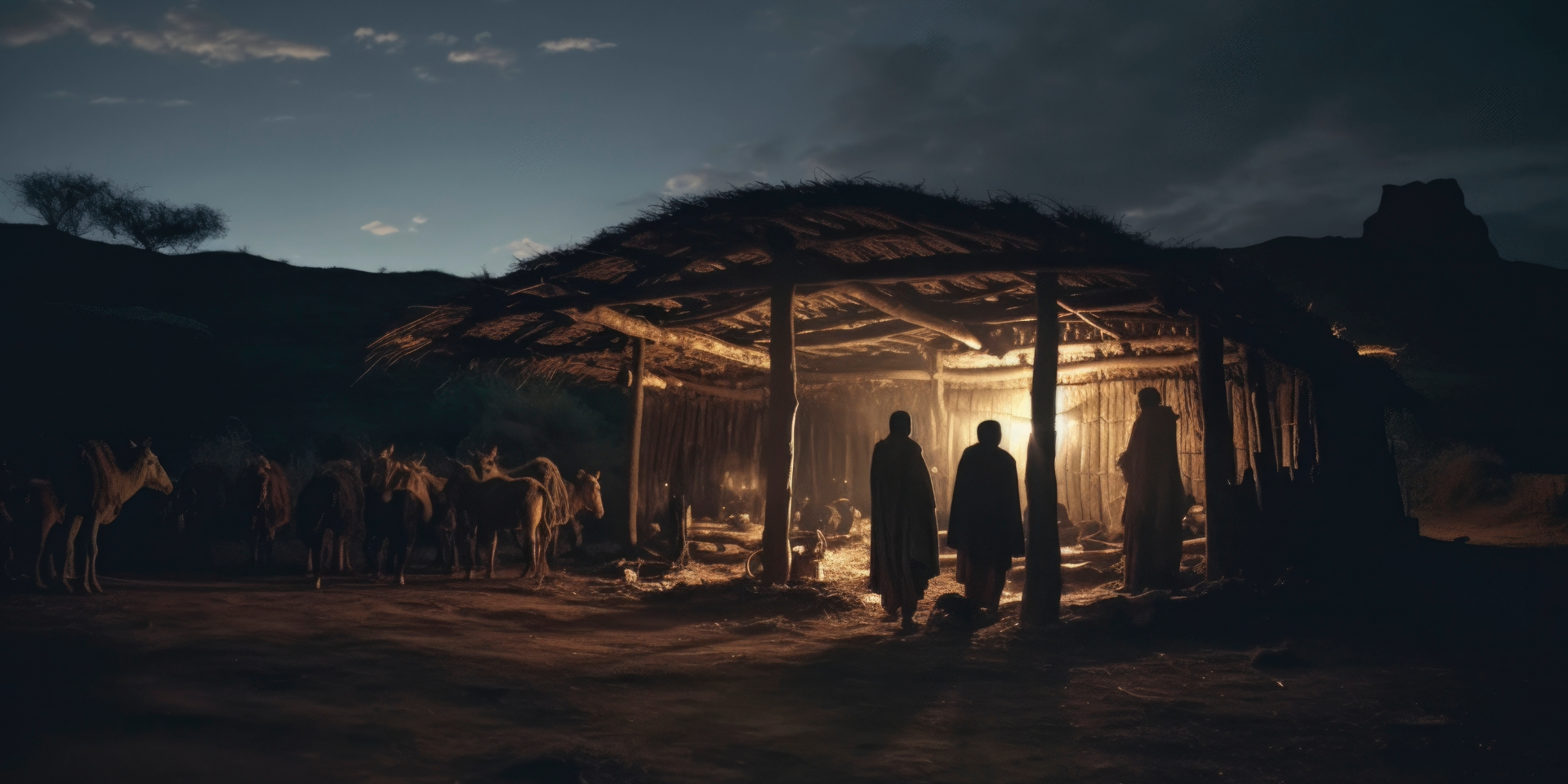
On the night when heaven descended among mortals, it was not the high priests or scholars who were the first to see God, but some lowly shepherds.
A thick darkness had fallen over the hills on the outskirts of Bethlehem. A few shepherds gather around a fire and watch the flames dance. Suddenly, the soft sounds of the night are interrupted by the shepherds’ fear when they see something they have never seen before: a shining angel descended from heaven and standing before them! The angel tries to calm them, telling them that he has come with “good news that will cause great joy for all the people” (Luke 2:10): a Saviour had been born right there in Bethlehem.
He then tells them that they will recognise Him because He will be wrapped in swaddling clothes and lying in a manger. As if unable to contain his enthusiasm, the angel begins to sing. He is joined by a great company of the heavenly host which had appeared with the angel, praising God and saying: “Glory to God in the highest heaven, and on earth peace to those on whom His favor rests” (Luke 2:13–14).
The shepherds’ amazement turns to immense joy, prompting them to set out immediately for Bethlehem to witness the miracle. And there it is: a swaddled baby lying in a manger with hay in a stable, just as the angel had told them. Thus, the shepherds became the first strangers, even before the Magi, to see Love incarnate.
But who were these shepherds on the night of the Incarnation? And why did the evangelist Luke consider it necessary to record their experience?
Pencil portrait
In first-century Judean society, being a shepherd brought neither wealth nor fame. In fact, according to tradition, shepherds were often considered to be part of the lower class of society. They were considered uneducated, despised, and dishonest because they were prone to letting their sheep graze on other people’s land, and unclean because their work often brought them into contact with dead animals or blood. Living outside settlements for months on end also meant that they could not observe holidays or attend the Temple. Therefore, shepherds were peripheral figures in society. Not even their testimony was admissible as evidence in the courts of the time.
However, Bethlehem itself has a long-standing pastoral tradition. One thousand years before the birth of Christ, the young David, who would become the king-prophet of Israel, grazed his flocks on those same hills. The Messiah was born into David’s family. Therefore, symbolically, the shepherds, the first to receive divine signs of the Messiah’s birth, are the humble successors of David, now called to pay homage to his descendant. The Messiah Himself would be known as “the Good Shepherd.”
His thoughts and our thoughts
Couldn’t the angel have appeared to Herod the Great or the high priest in Jerusalem? Of course he could have. But the angels felt more “at home” by the shepherds’ campfire. From His very first moment on Earth, God overturns human expectations.
“For my thoughts are not your thoughts, neither are your ways my ways,” says the Lord. “As the heavens are higher than the earth, so are my ways higher than your ways and my thoughts than your thoughts” (Isaiah 55:8-9). The birth of the Child is what brings peace between God’s thoughts and ours.
The role of the shepherds in Luke’s Gospel is unique; no one else was invited to the stable on the night of the birth. Although society denied them the right to testify, Christ the Lord chose the shepherds to testify to His birth. They were part of an intimate scene that included only His young mother, His protective father, and the choir of angels.
At the other end of Jesus’s life, at the resurrection, it is again the “untrustworthy” witnesses—the women—who are the first to receive the good news. The birth, resurrection, and life of Jesus Christ rehabilitate those marginalised in the eyes of the world, designating them as bearers of His revelation.
God’s actions strengthen our belief that no one is too lowly to receive the Good News. If God considered some marginalised shepherds worthy of seeing His Son in His most vulnerable form, then any person, no matter how humble, can partake in His love.
One might imagine that those shepherds had the expectation of the Messiah in their hearts, that they were different from their colleagues and that some special characteristic qualified them to become the first evangelists of the Christian faith, proclaiming to others what they had seen. However, subsequent stories in the Gospel of Luke, especially the parable of the prodigal son, show us that this is simply God’s way of acting. It seems to matter little to God who we are when we encounter Him or His representatives. Instead, like a parent who sees their child beyond school grades or profession, God sees something in us that even we cannot glimpse: what love can do in us.
An amazement that moves
After the angel’s appearance, the shepherds do not stand still, but start to move. Luke says that they “hurried off” (Luke 2:16). They don’t sit around wondering if it was a dream, if angels are real, or if it’s appropriate for them to get involved in such things. They simply leave. With their hearts warmed by the choir of angels, they do not keep the news to themselves, but share it with others.
The story of the birth of goodness among the simple resonates with people of all faiths and none. Perhaps out of an instinctive need for balance, we want goodness to be everyone’s right, not dependent on power, money, or status. When goodness comes among those at the bottom, we feel that moral order is being restored and that humanity is getting a new chance; that it is no longer being hijacked by those who are visible and loud.
In a way unique to Christianity, God quietly but firmly compensates for what people have distorted in full view of everyone. This is why, for us today, the story of the shepherds forms the backdrop to God’s call to all who wish to receive it. We may never hear a choir of angels in the night sky, but in moments when we feel insignificant, we can remind ourselves that only God has the right to judge. It is not our job to calculate merits—neither the merits of others nor, fortunately, our own.
As Alina Kartman notes, the story of the shepherds sees a form of faith reappear that does not require reputation, only wonder and the courage to “hurry off” towards the light.