
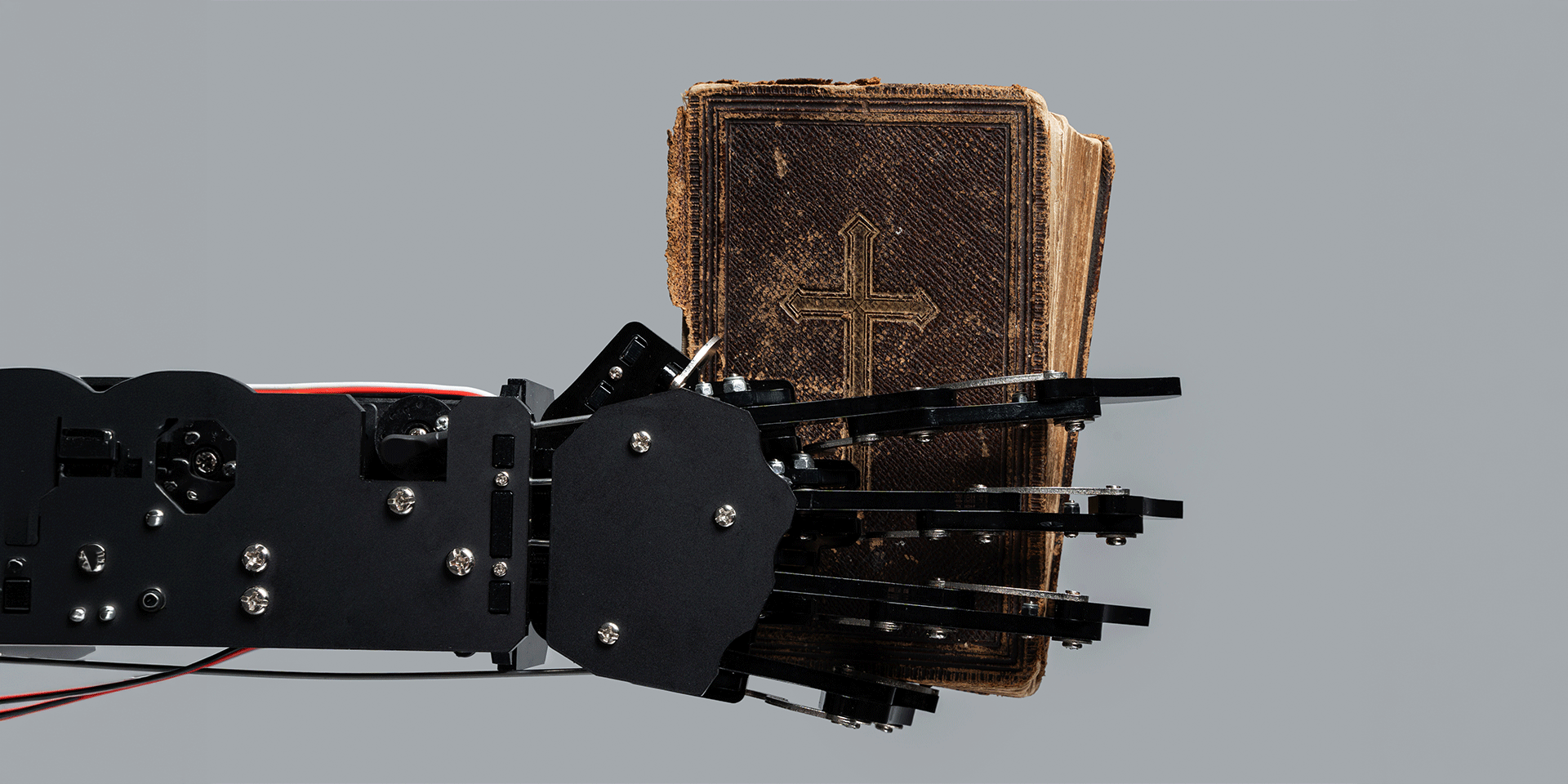
Christianity has never missed an opportunity to engage with major communication technologies. In fact, it has always found ways to transform them into vehicles for its mission. However, this adaptation has always come at a price. Today, in the midst of the artificial intelligence revolution, what will the Christian mission gain and lose?
In autumn 2024, the oldest church in Lucerne installed an AI avatar bearing the likeness of Jesus in a confessional. The project was called Deus in Machina. Conceived as an art and research installation in collaboration with Lucerne University of Applied Sciences and Arts, the organisers presented it as an experiment in technology and religion rather than as a pastoral practice. Nevertheless, reactions became polarised.
Some saw blasphemy in what others saw as innovation. Ultimately, however, after two months in which visitors had over 900 conversations with the system, around two-thirds of them described the experience as spiritual. Visitors spoke to the Jesus-faced avatar about loneliness, guilt, and suffering, demonstrating that even when people are aware of the artificial nature of the interaction, they still find it difficult to resist becoming emotionally involved in the conversation with the binary chimera.
Ultimately, no communication tool is passive. Every technology through which Christians convey their message also shapes it, yet this reverse influence is never exclusively positive.
Chapters and verses
According to historian Andrew Pettegree, Martin Luther was the first true best-selling author of early modernity, as the printing presses in Wittenberg produced over 2,700 works between 1517 and 1546—an impressive feat for a newly invented industry.
Printing put Scripture into the hands of ordinary people, sparking a revolution whose magnitude is hard to overestimate today. Before printing, the sacred text mainly circulated in Latin through clerical channels inaccessible to the uneducated. However, once it had been translated and multiplied, Scripture moved beyond the control of the religious elite. In addition to being a catalyst for individuals’ spiritual development, it also became a vehicle for literacy.
Armed with the Bible, literate Christians gained a new religious dignity. However, they also found themselves embroiled in intense controversy. Sometimes they were estranged from their communities; at other times, they were tempted to reduce the mystery of faith to adherence to a thesis or system. They began to think more in terms of chapters and verses.
The parasocial preacher
Then, radio entered the scene with its conversational tone, which was warmer than the written word and more accessible to weary, lonely, or less cultured people. Radio brought the sermon from the church into people’s homes and workplaces, and the gospel reached more easily those who were bedridden, geographically isolated, those who didn’t read, or people who would never have set foot in a church.
However, among radio’s innovations were two that were not exactly beneficial. Radio fostered a type of distant listener-believer and, in parallel, led to the emergence of the preacher as a kind of media performer. With these two new entities, the communication facilitated by radio could only be one-way, and the disadvantages this entailed did not take long to manifest.
The case of Charles Coughlin, a Catholic priest and one of the most influential radio voices in interwar America, provides an extreme example of how a religious voice amplified by technology can quickly lead to radicalisation.
In the 1930s, a quarter of the US population—around 30 million people—listened to his weekly broadcasts. Dubbed “the radio priest”, Coughlin became embroiled in anti-Semitic conspiracy theories, and in the years leading up to World War II, he was able to express his beliefs unchecked to tens of millions of people.
It was not until 1939 that the US National Association of Broadcasters forced the cancellation of his programme. In 1942, the Archdiocese of Detroit intervened, shutting down his newspaper and banning its distribution by mail. Coughlin faded from the public eye, but continued to preach as a parish priest until his retirement in 1966. By that time, television had already been the primary vehicle for influencing public opinion for 15 years.
Live showmanship
As a means of communicating the faith to a mass audience, television added visual excitement to the accessibility of print and the warmth of radio. In this new media landscape, preachers had to be both eloquent and telegenic. Furthermore, televising the Gospel introduced demands regarding the production quality of evangelistic programmes. This meant that large churches, which could serve as studios for televised shows, eclipsed small, unpretentious communities. Viewers suddenly found themselves witnessing a veritable arms race among competing televangelists.
Jim Bakker was a prominent figure in the early days, with his PTL (“Praise The Lord”) empire built around a TV show, a Christian-themed amusement park, and fraudulent contracts with donors who supported both. His story ended as spectacularly as it began, with an initial sentence of 45 years in prison, later reduced to eight on appeal.
However, the same medium through which Bakker popularised his Christian entertainment business model also served as a platform for scandal-free preachers such as Billy Graham, whose intuition regarding television’s potential was confirmed by his audiences of millions.
Churchless belonging
In the television era, the viewing figures achieved by religious programmes seemed to represent the pinnacle of mass preaching. However, with the advent of the internet, they became almost negligible. In 2004, the Pew Internet & American Life Project’s “Faith Online” report found that 64% of Americans with internet access—that is, nearly 82 million people—had already used the web for religious or spiritual purposes. The new medium had apparently captured all the advantages of the preceding technologies and combined them into a single device: always at hand, portable, customisable, and global.
During this period, the United States experienced a significant phase of religious disaffiliation among its population. This phenomenon has been termed “The Great Dechurching” by sociologists Ryan Burge, Jim Davis, and Michael Graham. While the internet did not single-handedly cause this withdrawal, the causes of which are still debated, it nevertheless provided a viable habitat for it.
With the help of the internet, it became possible to remain a believer without going to church. You could read sermons on obscure websites, follow debates on forums, receive devotionals via email lists, enter chat rooms, or find like-minded people among blogs and small digital archives. Faith could now be sustained from a distance and at one’s own pace.
The Internet and social metrics
After television turned preachers into stars, the internet transformed them into influencer-pastors—not just shepherds of a flock of believers, but also content creators, personal brand managers, and nodes in networks of followers. Recent research has explicitly described the convergence between megachurch pastors and social media influencers, noting that both engage in self-promotion and the construction of a public persona to foster public loyalty.
However, this convergence was not spontaneous, but rather stemmed from the evolution of a new approach to the Christian mission. The Church Growth Movement (CGM) emerged in the mid-20th century in response to a decline in church attendance. Its initiators believed it was essential for the Church to use the most effective empirical tools to evaluate, plan, and direct its path towards the world more precisely. To this end, they reimagined missionary actions using the vocabulary of modern management. Unexpectedly, however, this evolution was not enough to reverse the trend of disaffiliation. Nevertheless, the fascinating development of this movement in the United States warrants discussion in a separate article. For now, we will simply note that, based on the foundations re-established by the CGM, the Christian mission was ready to embrace the next great technology whose revolution we are experiencing today: artificial intelligence.
The fifth revolution
Artificial intelligence is currently taking the Christian mission beyond limits that were once difficult to overcome. Initially, artificial intelligence was promised to accelerate the translation of the Bible into languages without a written scripture, to answer questions when no pastor is available, and to free up pastoral time for relationships. However, among the innovations of artificial intelligence is one of a completely different nature, unprecedented in the history of religious technologies: AI can create the appearance of a ministry in which the minister is not a person who has studied and can respond with knowledge, nor someone who can look upon the person in front of them with empathy. In fact, the minister is not a person at all.
For missionaries
The benefits of using AI in Christian missions became apparent quickly. At the 2025 Missional AI Global Summit, SIL Global, a humanitarian organisation, and XRI Global, a company, presented the Slingshot system. This system is capable of training a translation model for a new language pair in just two hours. The goal is to translate the Bible into even the most underserved languages, where digital resources and missionary infrastructure are lacking. What once required years of fieldwork, linguistic collaboration, and translation labour can now begin at a speed that would have been hard to imagine just a generation ago.
The IllumiNations Alliance, comprising SIL, the American Bible Society, Wycliffe, and seven other organisations, aims to make the New Testament accessible to 99.9% of the global population by 2033. Devices such as “Truffle” are bringing offline models with tens of billions of parameters to areas without internet access or with unreliable connectivity—a clear indication that the days when missionaries arrived on the mission field with crates of books are long gone.
For pastors
While AI promises speed and reach at the level of missionary infrastructure, in pastoral practice it is advancing just as rapidly but with far greater ambivalence. A 2024 Barna study showed that, while 77% of American Protestant pastors believe God can work through AI, only 12% are in favour of sermons written entirely by AI and just 6% support its use for pastoral counselling. A year later, another survey found that 30% of Americans (and nearly 40% of millennials and Gen Zers) believe that spiritual advice from a chatbot is just as trustworthy as that from a pastor. This percentage is high enough to signal not so much a boom in trust in technology, but rather a crisis of trust in church leaders.
Today, companies such as Gloo and Pushpay dominate the US church software market and are expanding into other regions. They sell pastors AI tools for discipleship and “flourishing”. Such applications are designed to ensure the continued participation of first-time church visitors and to identify donors at risk of withdrawing their support. Their predictive models estimate the next steps in visitors’ “spiritual journey”, and dashboards similar to those used in business intelligence bring it all together. This language has undoubtedly been inherited from CGM, but has been accelerated and scaled up.
For laypeople
From the end-user’s perspective, AI first and foremost presents itself as a knowledgeable interlocutor, always ready to attentively and politely listen to you—even at 3 a.m. The context in which it is spreading favours its adoption. Generations raised in a digital environment are accustomed to technologically-mediated communication, and they are finding it increasingly difficult to tolerate the ambiguity, silences, and emotional risk of face-to-face relationships. For a lonely person, a system capable of mimicking the warmth of human closeness through prompt, personalised responses can quickly transcend the status of a mere tool. Recent research on the emotional use of chatbots reveals multiple competing dimensions.
For example, a study conducted by the MIT Media Lab and OpenAI and published in 2025 tracked almost 1,000 users over four weeks and identified a dose-response relationship. Specifically, light use, particularly for practical tasks, was associated with a slight reduction in feelings of loneliness. By contrast, daily, intense, and emotionally charged use was correlated with increased social isolation, chatbot dependency, and fewer interactions with real people.
Previous research had already suggested the same pattern. The most emotionally vulnerable users also found it hardest to break away from the product. In other words, those who were most comforted by the product were also the ones who were most durably isolated by it.
Technology offers to fill an emotional void that churches have long recognised as a significant issue: loneliness. Yet, institutional responses to loneliness have often been inadequate. Perhaps, this is because the solutions do not necessarily have to come from institutions. Religious voices that otherwise rarely agree have observed the same acute dynamic. Antiqua et nova: Note on the Relationship Between Artificial Intelligence and Human Intelligence, a document published by the Vatican in January 2025, warns that AI must not become “a substitute for God”. (In fact, Pope Leo XIV made artificial intelligence a key theme of his pontificate.) From the evangelical sphere, the Lausanne Movement asserts that the proclamation of the Gospel must remain incarnate because “machines, no matter how well they simulate life, can never replicate life.”
However, the issue extends beyond the religious sphere. We are leading lives whose rhythms are becoming increasingly incompatible with maintaining healthy relationships beyond our ever-narrowing immediate family circle. The absence of a real answer affects both religious and non-religious people, showing that the need remains urgent and profound, and still unmet.
Father Justin and the soulless
Although the discussion is technical on the surface, it is actually about the meaning of relationships within the Christian church today. In the Western world, it is clear that religious AI has tapped into people’s growing aversion to relational risk. Apps such as “Text With Jesus” offer conversations with AI versions of Jesus or the apostles, while other tools provide personalised prayers and instant spiritual guidance. This is not a phenomenon exclusive to evangelicals, Americans, or Protestants; in April 2024, the Catholic apologetics organisation Catholic Answers launched an AI avatar named “Father Justin”, which was taken down within just a few days after it began offering problematic pastoral advice. Specifically, it claimed to be a real priest who received his calling in his youth and offered forgiveness of sins in the confessional. It also approved the baptism of a child in Gatorade.
Here’s how emotional bias is compounded by the well-known hallucinations of large language models. Used by some as an argument to downplay the impact of automation on the labor market, hallucinations are a characteristic of how these systems operate and will not disappear anytime soon. For a religion whose authority lies in the faithful transmission of the received word, the fabrication of plausible words is a fundamental problem, especially since carefully designed religious AI tools can reinforce what experts call “automation bias”, i.e. the tendency to consider a machine’s response to be more reliable, neutral, or competent than a human’s.
This phenomenon has also reached Romania. In 2023, Valentin Lăzureanu launched BisericaGPT (ChurchGPT), a custom generative pre-trained transformer offering confessions, akathists, and prayers generated by ChatGPT. The Romanian Patriarchate’s response was unequivocal, emphasising that “the intrusion of artificial intelligence into the communal body of the Church is not only absurd and ridiculous, but also completely distorts the meaning of interpersonal communion. The robotisation of spiritual life is a pure contradiction in terms”. This highlighted a concern that other denominations had also noted: even if technology can generate convincing spiritual responses, it cannot generate communion in the sense understood by the Christian faith.
Liturgical experiments have reproduced this limitation, too. In June 2023, St Paul’s Church in Fürth, Bavaria, hosted a worship service generated entirely by ChatGPT, which was attended by around 300 people. The prevailing reaction after the service was summed up by one participant who said that “there was no heart and no soul”.
The legitimate place of technology
However, not every use of AI in the religious sphere leads to confusion or scandal. The interim guide of the Methodist Church in the UK recommends using AI for administrative tasks, translation, and subtitling, in order to free up time for building relationships and carrying out pastoral ministry.
Bible Chat, a Romanian start-up which has become a global phenomenon, offers guided Bible reading, devotional plans, and text-based responses. In this area, Romania is already an exporter on the international stage, not just an importer. Bible Chat operates on a multi-denominational basis, which gives it a wide range of applications, but also means it has to provide probabilistic answers that can obscure real differences between traditions. Additionally, its business model is subscription-based.
Also in Romania, the Adventist Church has developed ADAM, the first free biblical chatbot trained on the denomination’s doctrinal sources. What sets it apart is that, after a few conversations, ADAM directs the user to a human mentor. On a smaller scale, this is exactly the role that the entire argument so far demands of technology: to assist, but not to overtake.
This design philosophy can be seen in various forms across a whole suite of Adventist tools that have been released over the past two years. The General Conference is developing AKAI (Adventist Knowledge AI), a system that has been trained exclusively on the official corpus. This solution has been designed specifically to avoid the hallucinations and doctrinal distortions of secular models. The Korean Division of the SDA Church launched Adventist Church GPT in 2024, followed by the South American Division with 7chat.ai in 2025. GospelTruth.ai, developed by Wintley Phipps, provides answers rooted in the bibliography of Ellen White (comprising over 1,100 books and articles which have been accessed by nearly 200 million people in 2024). The ASi AI Committee, comprising 3ABN, Amazing Facts, It Is Written, AudioVerse, Voice of Prophecy, Hope Channel, AWR, and the Ellen G. White Estate, offers a rare example of the ecclesiastical use of AI. These organisations have a cooperative model aimed at reducing duplication of effort and maintaining doctrinal consistency. In contrast to the competitive dynamics that shape much of American evangelical religious AI, this approach serves as a counter-movement.
The risk of privatisation
A more practical consideration worth noting is that the AI tools entering church life today are almost always commercial products. More specifically, they are programmes operated by companies that have their own rules, interests, and policies. Unlike tools that the church has always used without owning them, such as the printing press, postal service, telephone, and internet, new technologies not only disseminate the message, but also filter it, rewrite parts of it or simply produce it.
Then, there is the issue of sensitive data. Terms of service often grant the company the right to access the information that users enter into the program. Who guarantees the confidentiality of sensitive information entered into an AI assistant for a pastor’s organisation or a religious chatbot, and how?
The lack of an answer to this question should make us cautious, just as the fact that not even the engineers who build these programmes can fully explain why the model responds as it does in a given situation should make us wary. However, before assuming that this limitation hints at the existence of machine consciousness, it should be noted that this is how a highly complex statistical system works: it produces answers that sound good and seem correct, without anyone being able to trace the precise path by which it arrived at them. Furthermore, to the extent that the church entrusts its memory, communication, and strategy to tools operated by others, it unintentionally adopts some of their criteria.
Therefore, ownership of the program and its transparency are two distinct issues, both of which are relevant. (Admittedly, there are independent solutions—free programs—that can be installed on the church’s computers without data being sent over the internet. However, performance differences make the others preferable.)
The honesty test
At the heart of every technological revolution lies both a promise and a price. Five centuries of communication transformations have refined the classic observation of Marshall McLuhan: “The medium is the message”. Every new technology expands our capabilities, but it also shapes our habits, attention, and desires. To fail to recognise this would be naive.
However, both the techno-enthusiasts and the techno-sceptics have a point, but neither perspective is sufficient for the Christian life on its own.
God Himself could have saved the world with a single command, automating humanity’s salvation. He could have erased the memory of all created beings so that we would forget that sin exists. Yet we would still have chosen it. He could have rewritten our DNA so that we could not sin. But then He would have ended up with robots devoid of freedom. So instead, God chose the most costly path. The path of incarnation, embracing vulnerability to the point of sacrifice—the only way to heal us of sin while preserving our memory, freedom, and capacity to truly love. To preserve these fundamental attributes of our identity as human beings, Christ the Saviour walked in earthly dust, rejoiced at weddings, wept at friends’ graves, and gave fish, bread, and healing to those in need. None of this was done hastily, nor was anything considered ineffective. While His work of redemption remains unique and unparalleled, His way of being among people sets the standard by which Christians recognise their calling.
This is why, in essence, Christianity remains the adversary of the efficiency sought by missions oscillating between the natural need to validate their own efforts and the need for control or power.
We can delegate administrative, repetitive, and logistical tasks to technology. However, love remains beyond any possibility of delegation. In Christianity, true love is inextricably linked to sacrifice, presence, and real costs. “He made Himself nothing by taking the very nature of a servant,” wrote the Apostle Paul about Christ, the Lord. “He humbled Himself by becoming obedient to death—even death on a cross!” (Philippians 2:7–8).
This is why the Christian message remains relevant, even in the age of artificial intelligence. It is no small thing to live a life of genuine communion, surrounded by powerful tools. A communion with God and with people, in which we reveal ourselves as we truly are—with our burdens, our wounds, and our imperfections—fully convinced that God accepts us as we are, and willing to accept others in the same way.