
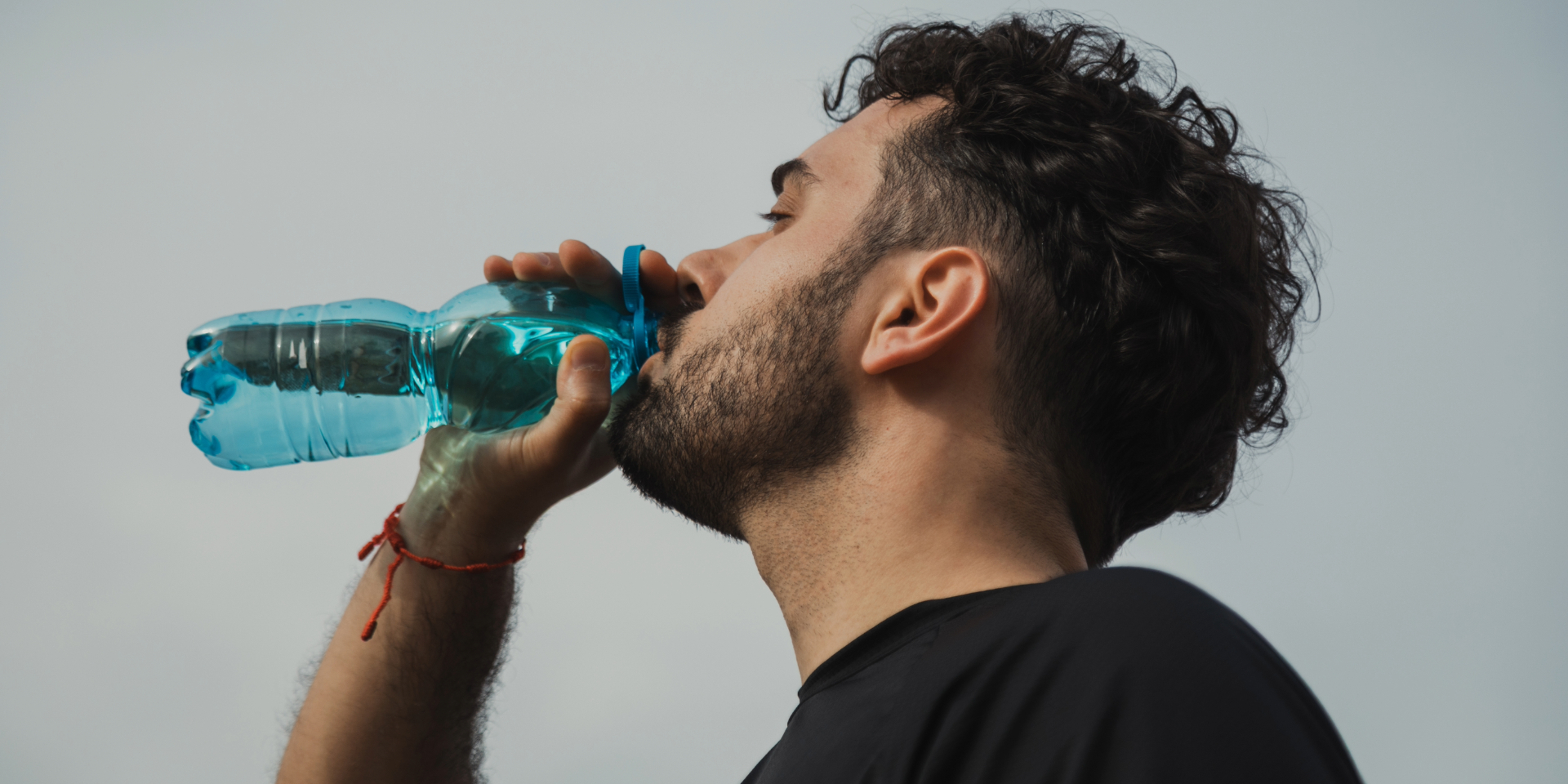
The question of the origin and justification of the recommendation to drink at least eight glasses of water a day was first seriously examined in a scientific publication by Heinz Valtin.
Myth: You need to drink eight glasses of water a day.
Heinz Valtin identified two possible origins of the “eight glasses a day” idea, neither of which is based on experimental or clinical data. The first possible source is linked to nutritionist Fredrick J. Stare, who is said to have been “an early champion of drinking at least six glasses of water a day.” Examining Stare’s work, Valtin identified the following passage from a book co-authored with Dr. Margaret McWilliams in 1974:
“How much water each day? This is usually well regulated by various physiological mechanisms, but for the average adult, somewhere around 6 to 8 glasses per 24 hours and this can be in the form of coffee, tea, milk, soft drinks, beer, etc. Fruits and vegetables are also good sources of water.” (Valtin 2002).
Commenting on this passage, Valtin made several observations:
a) This is the authors’ opinion, unsupported by any scientific experiment;
b) There is a significant difference between “somewhere between six and eight glasses” and “at least eight glasses”;
c) Both alcoholic and non-alcoholic beverages are included in estimating water intake;
d) The original statement is introduced with the note that water intake is “usually well regulated by various physiological mechanisms,” whereas proponents of the 8×8 rule (eight 8-ounce glasses, or about 237 ml each) tend to argue that relying solely on these mechanisms would lead to dehydration.
A second origin identified by Valtin refers to a 1945 statement by the Food and Nutrition Board of the U.S. National Research Council, which stated that “a suitable allowance of water for adults is 2.5 liters daily in most instances. An ordinary standard for diverse persons is 1 milliliter for each calorie of food. Most of this quantity is contained in prepared foods.” In this case as well, the statement was not retained in full, as the final sentence was largely ignored.
Therefore, the origin of the recommendation to consume at least eight glasses of water per day remains uncertain and is not grounded in experimental or clinical evidence.
In 2013, William F. Clark and his colleagues revisited the issue of the eight glasses of water per day in a new scientific article. In its introduction, they noted that as “scientists turn their attention to studying this issue, there is now a small but growing body of evidence that increasing fluid intake may have health benefits” (Clark, Susan Huang et al. 2014). Most of the article focus on the analysis of four observational studies examining the correlation between fluid intake and the slowing (or not) of kidney function decline. Three studies suggested that increased fluid intake may slow kidney damage, while the fourth indicated the opposite—a faster decline in kidney function. The authors concluded that the evidence is currently balanced and that the question could be resolved through a randomized clinical trial, which, for the time being, appears not to have been conducted or published.
How much water should we drink each day? For now, there is no definitive answer. It seems unlikely that eight glasses a day represent the minimum intake for every individual, given the significant differences in age, sex, body weight, metabolic activity, and climate. On very hot days, for instance, more water is lost through perspiration, increasing individual requirements.
A large-scale study published in 2022, conducted by researchers from at least three continents and 78 institutions across multiple countries (Yamada, Zhang et al. 2022), analyzed the body’s water needs and concluded that water requirements cannot be the same for everyone. The widely circulated recommendation that all individuals should drink around eight glasses of water (approximately 2 liters) is “not backed up by objective evidence.”
One unresolved—and difficult to resolve—issue concerns how much water is obtained from food. Cross-sectional studies based on self-reported questionnaires suggest that approximately 20–50% of daily water intake comes from food. However, such estimates have often been shown to be inaccurate. Without knowing how much water is provided by the foods we consume, it is impossible to determine precisely how much water a person should drink in a day.
That said, the rejection of the “eight glasses” rule should not lead to dismissing the importance of hydration altogether. Evidence has accumulated suggesting that higher water intake may have beneficial effects in preventing certain conditions or slowing their progression. Until clearer data become available, rather than adhering to a fixed number of glasses, the sensible approach is to ensure adequate hydration while avoiding excess.
References
- Clark, W. F., Susan Huang, S. H., et al. (2014), “‘Drink at least 8 glasses of water a day to be healthy???’”, in Home Healthcare Nurse, vol. 32, no. 4, pp. 237–242 (this article reproduces the one originally published in Nutrition Today, Vol. 48, Supplement 4, 2013, pp. S18–S21).
- Valtin, H. (2002), “‘Drink at least eight glasses of water a day.’ Really? Is there scientific evidence for ‘8×8’?”, in American Journal of Physiology: Regulatory, Integrative and Comparative Physiology, vol. 283, no. 5, pp. R993–R1004.
- Yamada, Y., Zhang, X., et al. (2022), “Variation in human water turnover associated with environmental and lifestyle factors”, in Science, vol. 378, no. 6622, pp. 909–915.