










Martin Luther is one of the most famous figures in history. Of those born in Germany, only Einstein, Bach, and Beethoven are more famous. He is better known than the father of communism, Karl Marx, the literary genius, Johann Wolfgang von Goethe, the artist, Albrecht Dürer, and the inventor of the printing press, Johannes Gutenberg.[1]
Beyond all his achievements, Luther was a figure capable of intriguing anyone. He developed his theology in an environment of fierce debate and was a theologian endowed with a remarkable gift for rhetoric[2]—”a fighter for the Word of God.”[3] “I am born to fight against innumerable monsters and devils,”[4] he said of himself.
Luther’s polemic was partly influenced by the Augustinian view of history and his apocalyptic expectations.[5] In his view, the conflict between Satan and God, and between the false and true churches, had been ongoing since the time of the apostles. For him, the struggle between good and evil constituted sacred history itself.
Within this paradigm, the papacy was the Antichrist, the Turks were Gog, and the Jews of his day represented the remnant of a people experiencing God’s wrath, whilst his Protestant opponents were false prophets and apostles. Luther was shaped by his times: a dark era in which demonisation and burning at the stake were commonplace.
In defence of conscience
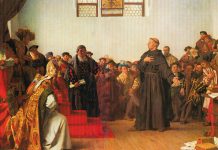
In the early stages of his work as a reformer, the concept of freedom occupied a central place in Luther’s thinking. His words before the Diet of Worms in 1521 were emblematic: “I cannot and will not recant anything, for to go against conscience is neither right nor safe. Here I stand, I can do no other, so help me God. Amen.”[6]) They represent a source of inspiration and a true battle cry against medieval tyranny and a call for liberation from the shackles of the monolithic Catholic religious establishment. The German reformer earned a reputation as a defender of conscience, at whatever cost.
By translating the Bible into German and providing free access to Scripture unmediated by any ecclesiastical authority, Luther offered the German people Christian freedom, freeing them from the straitjacket of indulgences and works of salvation. This was only made possible by the unintended “divorce” from the Catholic Church.
In his 1520 essay “On Christian Liberty,” Luther stated that “a Christian is a perfectly free lord of all, subject to none. A Christian is a perfectly dutiful servant of all, subject to all.” With these words, Luther entered the annals of freedom-of-conscience heroes, whilst also making a significant contribution to the formation of the concept of personality and the development of individuality. To this day, the essence of Protestantism lies in “an assertion of the right of the individual as such to think things out for himself and to reach conclusions without deference to any sort of authority.”[7]
The limitations of the visionary
Although he was a pioneer of freedom of conscience and faith, Martin Luther was not tolerant of all religions. Initially, he spoke highly of the Jews because they opposed the Catholic Church.[8] In 1523, he wrote the treatise “Jesus Christ was Born a Jew”, whose ideas were enthusiastically received by Jews across Europe.
Adopting a satirical tone, Luther defended the Jews, urging Christians to embrace the truth in the hope that the Jews—kin to Jesus by blood and by faith—might return to the faith of Abraham, Isaac, and Jacob. In the same letter, he urged his fellow Christians to stop treating the Jews like dogs by forbidding them from doing any work or running any businesses, thereby driving them into usury.
Rather than treating them according to papal law, Luther argued that we should love them with the love of Christ. If some of them were stubborn, he said, they should be tolerated, as some Christians were the same. Over time, however, Luther’s discourse took on radical overtones. In “On the Jews and Their Lies” (1543), he is contemptuous and arrogant; the Jews were blamed for greed and deceit.
Several attempts have been made to explain this shift in Lutheran axiology. Communication in that antisemitic era, the deterioration of his health in his later years, the frustration caused by the obstacles the Reformation encountered, its fragmentation into various movements, or certain negative experiences the reformer had with Jews have all been cited to explain Luther’s hostile statements.
Five hundred years ago, the concept of freedom of conscience did not exist. However, history was about to change, thanks to a young German priest named Martin Luther.
The decisive factor was probably the Jews’ stubborn refusal to convert, as identified by Luther himself. As early as 1520, the year in which he wrote the treatise “Jesus Christ was Born a Jew”, the German reformer expected the Jews to accept Jesus (“We might convert some of them”). Luther had heard rumours about Jews teaching the catechism to Christians, which convinced him to write “Against the Sabbatarians” in 1538.
In Luther’s time, Jews were not tolerated in any of the towns where he lived. In the superstitious mindset of the era, Jews were blamed for all sorts of evils, including witchcraft, poisoning water supplies, destroying grain crops, desecrating holy objects, and performing rituals involving the murder of Christian children. Influenced by the ethnic imagery and stereotypes of the time, the German preacher proposed abusive measures against the Jews, including the burning of synagogues, the destruction of homes, the confiscation of books, and the relegation of Jews to a lowly agricultural labouring status. The “final solution” was the expulsion of Jews from the country. Fortunately, Luther’s plan only had a moderate influence on the authorities of the time.
However, the triumph of National Socialism during the Third Reich breathed new life into these writings. In November 1938, the Bishop of Thuringia celebrated Kristallnact (“The Night of Broken Glass”) as the fulfilment of Lutheran hopes. On 10 November, Luther’s birthday, synagogues were set alight, and the voice of the “German prophet” was transformed into the most powerful antisemitic voice. After the war, at the Nuremberg trials, Julius Streicher, the master of antisemitic propaganda, claimed that his inspiration, Martin Luther, should have been condemned in his place.
According to Mark Edwards[9], Luther also targeted Catholics, Turks, and Protestants with his crude rhetoric. Thus, although he defended the freedom of conscience of believers who prioritised Scripture over tradition, Luther failed to recognise the need to grant the same freedom to those who were, in his view, theologically mistaken.
While Luther’s views on the “Jewish question” must be analysed in the context of his era’s mindset, this is not an attempt to exonerate him. Despite the mindset of the era, Luther’s contemporaries managed to understand the divine principles underpinning religious freedom and freedom of conscience.