









Choir rehearsal had begun only five minutes earlier, but I was already restless. Using a convenient excuse, I slipped out quietly, thinking about the crooked piece of rebar I had hidden a week before. It was exactly what I needed to force open the lock on the door without a handle, deliberately left that way so no one could enter the construction site of the new church.
Within seconds, I was already inside. The floor was covered in dust, wooden beams supported the unfinished walls, and twisted metal rods curled through the concrete like tentacles. I moved quickly, without thinking too much. I climbed the scaffolding, jumped across carelessly placed boards, grabbed onto ropes and support bars. Sometimes I squeezed through narrow gaps; other times I used a makeshift pulley to pull myself up to the next level.
It had become an almost weekly ritual. I already knew the safest routes, where the planks bent under weight, and where the dust concealed rusty nails. I knew how to climb higher, how to descend faster, how to keep my balance when the structure beneath me was unstable.
But one day, someone saw me. I had not made it very far when I heard an adult’s voice echo loudly across the church courtyard. For a split second, I froze. Then determined footsteps drew closer, and my secret exit was no longer an option.
This time, I had been caught.
When rules become chains
As the years passed, I stopped climbing scaffolding and started climbing ideas. I could never accept rules simply because “that’s the way things are done.” It was not enough for me to comply; I wanted to understand, to discover better methods. Whenever I was told that something had to be done in a certain way, I would always ask, “Why?” And if the answer was, “Because it’s always been done this way,” I immediately lost interest.
But what initially seemed like a strength—critical thinking, the desire to innovate—eventually began to isolate me. Too many conflicts, too many attempts to do things differently, too many uncomfortable questions. Instead of feeling free, I felt trapped by my own struggle.
And then I encountered one of the most surprising meetings in the life of Jesus: the moment at the well.
The real question is not “Where?” but “How?”
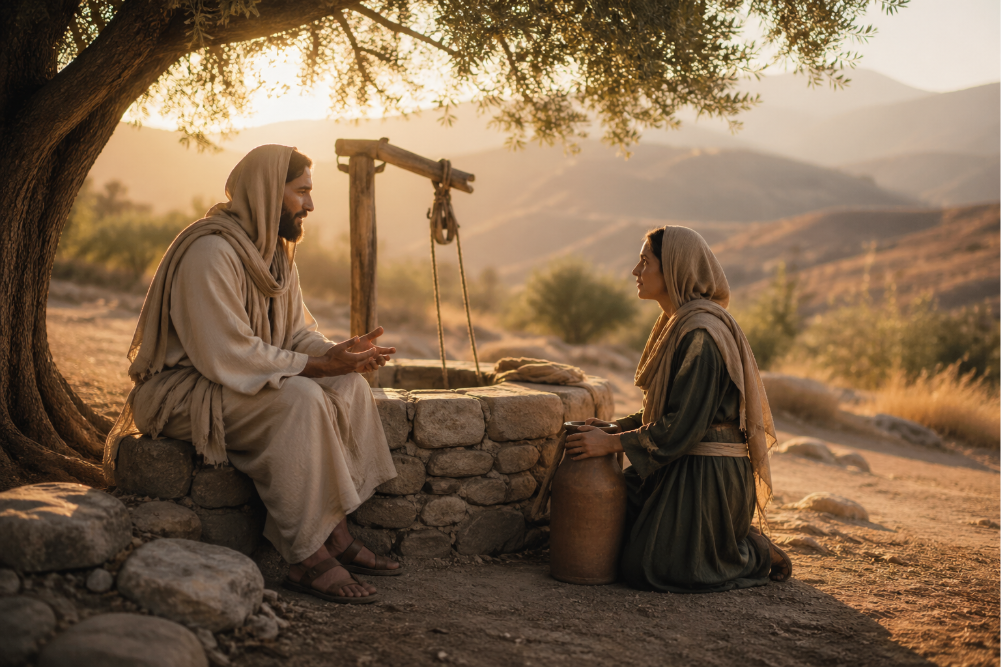
The Samaritan woman had come to the well at noon, when everyone else avoided the heat, probably because she did not want to run into anyone. When Jesus asked her for water, she was surprised—Jews did not speak with Samaritans, and a man did not approach a woman who was alone. But what followed was truly remarkable.
Jesus began speaking to her about “living water,” about a thirst deeper than physical thirst. Then, with a single sentence, He revealed her past: “You are right when you say you have no husband. The fact is, you have had five husbands, and the man you now have is not your husband” (John 4:17–18).
For the woman, this could mean only one thing: the man standing before her was at least a prophet. Someone who knew the Law, someone who held authority not only over her past, but over truth itself. That is why she asked, “Our ancestors worshiped on this mountain, but you Jews claim that the place where we must worship is in Jerusalem” (John 4:20).
It was not a diversion, but a sincere question, born from the conviction that Jesus could give a real answer. In the presence of a prophet, personal details no longer matter most; the fundamental questions of faith do. Jesus did not rebuke her for asking. Instead, He offered a truth that transcended every theological dispute: “Yet a time is coming and has now come when the true worshipers will worship the Father in the Spirit and in truth” (John 4:23).
The place does not matter. The ritual does not matter. Convention does not matter. Authenticity does.
The freedom to be authentic
A fixation on rules appears when you are trying to save yourself; when you feel the need to prove something; when you want to be superior to others, to show that you are more righteous, more devoted, more worthy of God. But Jesus shows that true faith is not about following rules for your own salvation; it is about seeking truth and serving others.
Just as the well was not really about water, but about the thirst of the soul.
Just as worship was not really about mountains, but about a relationship with God.
And then I understood: my struggle was not meant to be against rules, but against superficiality. Against hypocrisy. Against a life in which you do things simply because you are supposed to, without truly believing in them. That is why I believe this is the true meaning of repentance: not a formality, not a change in behaviour driven by fear or conformity, but an authentic inner transformation.
I chose to follow Jesus, not by adhering to a list of rules but by striving to be authentic. Sometimes that means respecting conventions; other times, questioning them. But always—absolutely always—it means being honest before God. And perhaps true freedom does not mean escaping limits but understanding their purpose. Knowing when to respect them and when to go beyond them. Having the courage to stop trying to prove anything and simply live the truth.
Cosmin Sturzoiu reflects on some of the obstacles that blocked his path toward a genuine relationship with Jesus, as well as the process through which he ultimately discovered the secret of transformative discipleship.