











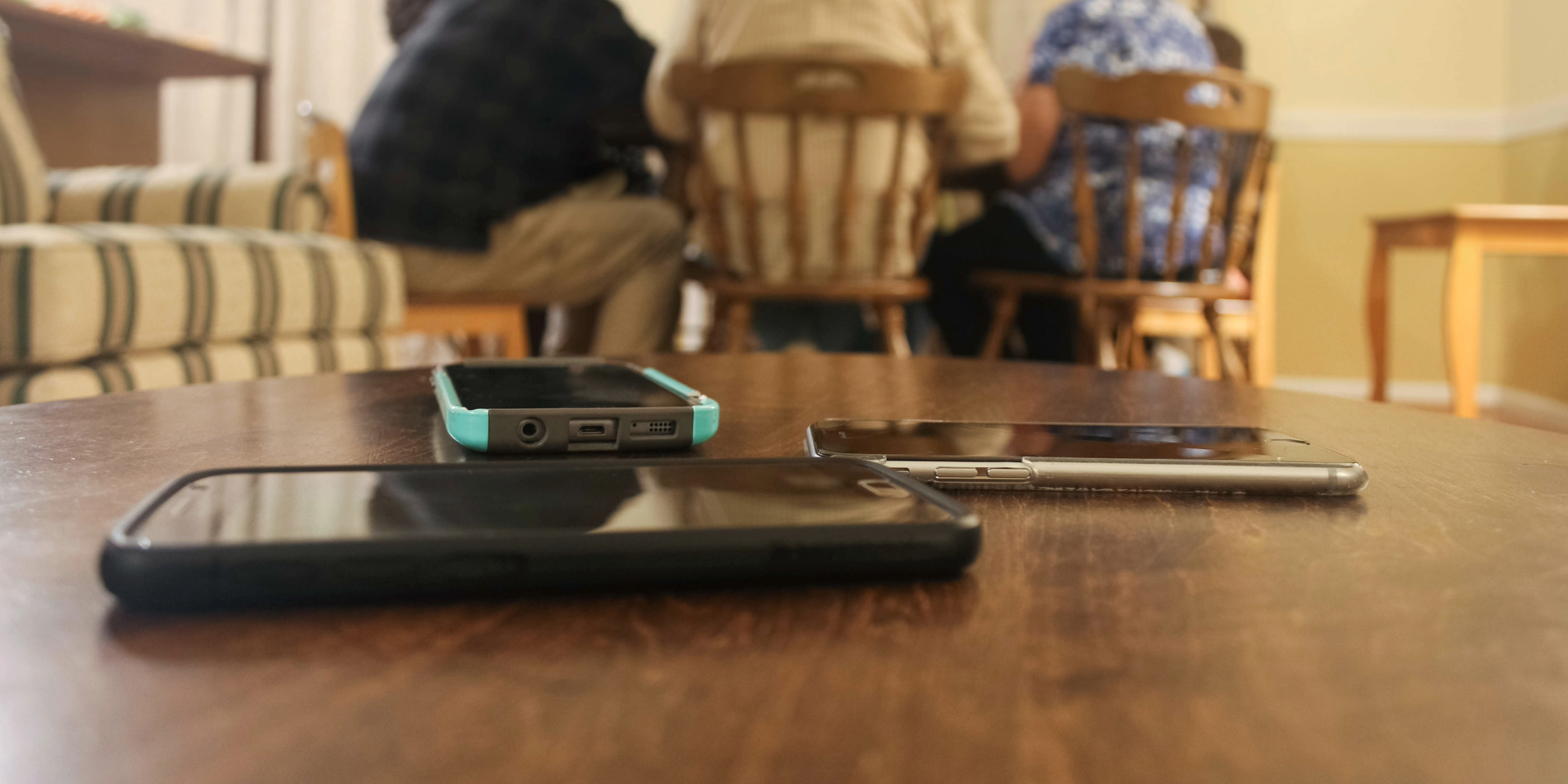
The phone lies face down on the table. It doesn’t make a sound. Yet, everyone in the room senses its presence, just as we sense someone’s gaze on the back of our neck.
Keynotes:The problem: even when it is switched off, a phone on the table can drain our mental resources simply by being there. The brain expends energy to ignore it. What the research shows:
The cultural argument: The mobile phone functions as a secular liturgy that shapes our desires through repetition, just as religious rituals once did. Books and mobile phones demand opposing ways of being: one requires patience and receptiveness; the other, control and an immediate reaction. The proposed solution is not a temporary “digital detox”, but rather a way of life. This involves keeping phones out of the bedroom, spending the first hour of the day without screens, eating meals without phones, prioritising books over social media feeds, and making notifications the exception rather than the norm. Conclusion: Not a world without phones, but one in which phones resume their role as tools and nothing more. |
Researchers from the University of Texas at Austin have shown that the mere proximity of a mobile phone, even with the screen off, drains our mental resources. This effect is evident even when we resist the temptation to check notifications. The intention to ignore the device puts a strain on the brain and reduces our ability to be truly present.
It wasn’t always like this. Initially, we all felt that the phone offered things that, before its advent, belonged more to the realm of the imagination. It offers the ability to talk to anyone, no matter how far away they are; the ability to see and be seen by the person you’re talking to; and having the whole of the internet and its infinite possibilities at your fingertips wherever you are. These are all benefits that many of us can no longer imagine living without. (If we do imagine life without them, we picture it as rather primitive and limited.)
Yet, the same smartphone that has given us so much has begun to take its toll on our attention, rest, and relationships in such small increments that we didn’t notice at first.
In a study conducted at UC Irvine, scientists found that our attention span while looking at a screen has diminished considerably in recent years. Objective measurements using logging techniques have recorded an almost linear decline: from around 2.5 minutes in the early 2000s to 75 seconds in 2012 and just 47 seconds today. This is in addition to the fact that, once interrupted from a task, it takes us around 25 minutes to refocus. This means that, for a three-second message, we pay the price of nearly half an hour of thinking time.
We also pay the price in terms of our night-time sleep. A 2025 systematic review confirms the negative impact of smartphones on sleep. This has two mechanisms: the phone either delays or interrupts sleep, and the light from the screen suppresses melatonin. Furthermore, the emotionally charged content we may have consumed in the evening keeps us alert. A controlled clinical trial involving students in Serbia also verified this, finding that reducing blue light in the evening significantly improved sleep quality.
Then, there is the cost in terms of strained relationships. A 2013 study showed that the mere presence of a mobile phone can interfere with relationships, particularly when discussing important matters. This was also demonstrated in a real-world setting in a café: people who had their phone on the table rated their conversation as less fulfilling and felt that the person they were talking to showed them less empathy. Admittedly, this effect cannot be replicated entirely, but even considering its context dependence, the impact of the mobile phone is undeniable; it is merely a matter of measuring it.
These measurements map out the contours of a revolution that we once regarded as purely technological, but which is now transforming the way we think.
Humanity has experienced this sort of disruption before
Following the advent of the printing press, the reading revolution first transformed the way people spent their time before changing the very architecture of their thinking.
As schooling became more widespread and cheaply printed material began to circulate beyond privileged circles, reading gradually became a habit of the masses. According to the journalist James Marriott, this was powerful enough to shape the intellectual reflexes of entire societies.
Books democratised access to information while simultaneously cultivating patience, introspection, memory, and the ability to follow an argument across several pages and to its ultimate conclusion. It is in this mental discipline that we can identify one of the conditions that made the Enlightenment, scientific progress, and liberal democracy possible.
Today, however, Marriott argues that this intellectual infrastructure is beginning to erode under the pressure of smartphones, social media, and the constant stream of images, notifications, and snippets of information. Reading survives, but it is increasingly a hurried, fragmented activity subject to distraction, while long, dense, or demanding texts require a level of attention that the digital environment is making increasingly difficult to sustain. Marriott calls this condition “post-literacy”, describing an era in which people retain the technical ability to decipher words, yet are gradually losing the cognitive habits associated with deep reading. Continuity is replaced by impulsiveness and interruption, and the mind, accustomed to constant stimulation, begins to struggle with silence, complexity, and prolonged intellectual effort.
Addiction, an inadequate concept
Mobile phone addiction is not currently recognised as a distinct diagnosis. Specialist literature uses the more cautious term “problematic smartphone use”, but this does not yet have a clinical definition or universally accepted thresholds either. Screen time, viewed in isolation, provides little information about the severity of the situation. More relevant indicators include loss of control, distress, or impairment of daily functioning, relationship conflicts, disturbed sleep, and continued use despite the consequences. However, even below the threshold of a disorder, the phone can shape our attention, redefining our conventions of presence and response.
The device that educates
We check our phones in the morning, even before our first prayer. We doomscroll in bed before going to sleep. We look at the screen when there is an awkward silence in a conversation. We watch for reactions after posting something. We refresh the feed repeatedly, as if answering a call to prayer, except this time it’s not God but our phones.
Our phones shape our desires, and they do so through repetition. James K. A. Smith, the editor-in-chief of the magazine Comment, has termed these repeated practices “liturgies” because they function like religious rituals, shaping our hearts and affections. In You Are What You Love: The Spiritual Power of Habit, Smith demonstrates that these cultural rituals influence our desires more profoundly than the ideas we consciously embrace.
Smith argues that Christian worship is a direct counter to these rival liturgies. The Gospel of John refers to Christ as the Word, or Logos, through whom all things were made. Faith in the Word demands the kind of attention a book requires: patient concentration, ready to receive a meaning slowly revealed. However, screens train us in the exact opposite mindset, promoting a hasty dominance of stimuli. This is why, according to Smith, reclaiming reading is synonymous with reclaiming the capacity to receive revelation.
Two ways of being
Smartphones and books essentially demand two different ways of being from us: smartphones condition us to maintain control over an endless stream of stimuli; books, on the other hand, invite us to become guests in someone else’s mind, accepting the order and obsessions of that mind for a time.
James Marriott quotes Orality and Literacy, the volume in which Walter Ong demonstrates that writing not only records thought, but also alters its structure. Speech exists only in the moment it is uttered, which is why oral cultures tend to think in terms of set phrases, repetitions, and easily memorable expressions. Their discourse also tends to be polemical, closely tied to concrete experience and the listening community.
The architecture of written thought enables systematic, ramified thinking that can verify its own consequences. Marriott illustrates Ong’s idea through an exercise in counterfactual imagination. What would it be like to deliver a vast philosophical system, built from hundreds of pages of interlinked reasoning, from memory? This would not be possible without the argument collapsing; either the speaker would lose the thread of their ideas or contradict themselves, or the listener would be unable to follow the argument throughout. The reader, on the other hand, can pause, re-read an unclear passage, or check whether an idea from an earlier part of the text ties in with one from a later part.
This is how an ancient Christian virtue reveals its civic aspect. The Epistle of James urges people to be quick to listen, slow to speak, and slow to anger. It places receptiveness before expression and deliberation before reaction.
Indeed, our modern culture, which idolises the immediate response, needs to listen even more than it needs politeness. This is because listening is a form of resistance and a literacy of the heart. Without it, the literacy of the mind gradually loses its power to sustain a shared world.
Why a digital detox is not the answer
Of course, taking breaks from screens helps. However, they are all too often treated as an individual remedy for a collective problem. We need more than just breaks; we need lifestyles in which the smartphone is no longer the automatic response to any discomfort.
The evidence points precisely in this direction. A rigorous study published in PNAS Nexus in 2025 showed that restricting mobile internet access for two weeks improved participants’ sustained attention, mental health, and well-being. The improvement in attention was comparable to the effect of a ten-year rejuvenation. Without constant access to the network, people spent more time socialising face-to-face, being active, and spending time in nature. One of the simplest and most effective measures is keeping the phone out of the bedroom. However, the emphasis is on principles rather than tricks.
Admittedly, the phone can also be a tool for caring. We use it to call our parents, summon help, request support, maintain contact, find our way, work, photograph our children, listen to music, read, occasionally pray, and socialise. Perhaps, that is why the real longing should not be for a world without phones, but for a world in which they occupy their rightful place—that of a tool, not a master.
What or who should come first? First, God; then the person in front of me; the child who speaks to me; the body that needs to be nourished and given sufficient rest; a job well done; and friendship that cannot be rushed.