











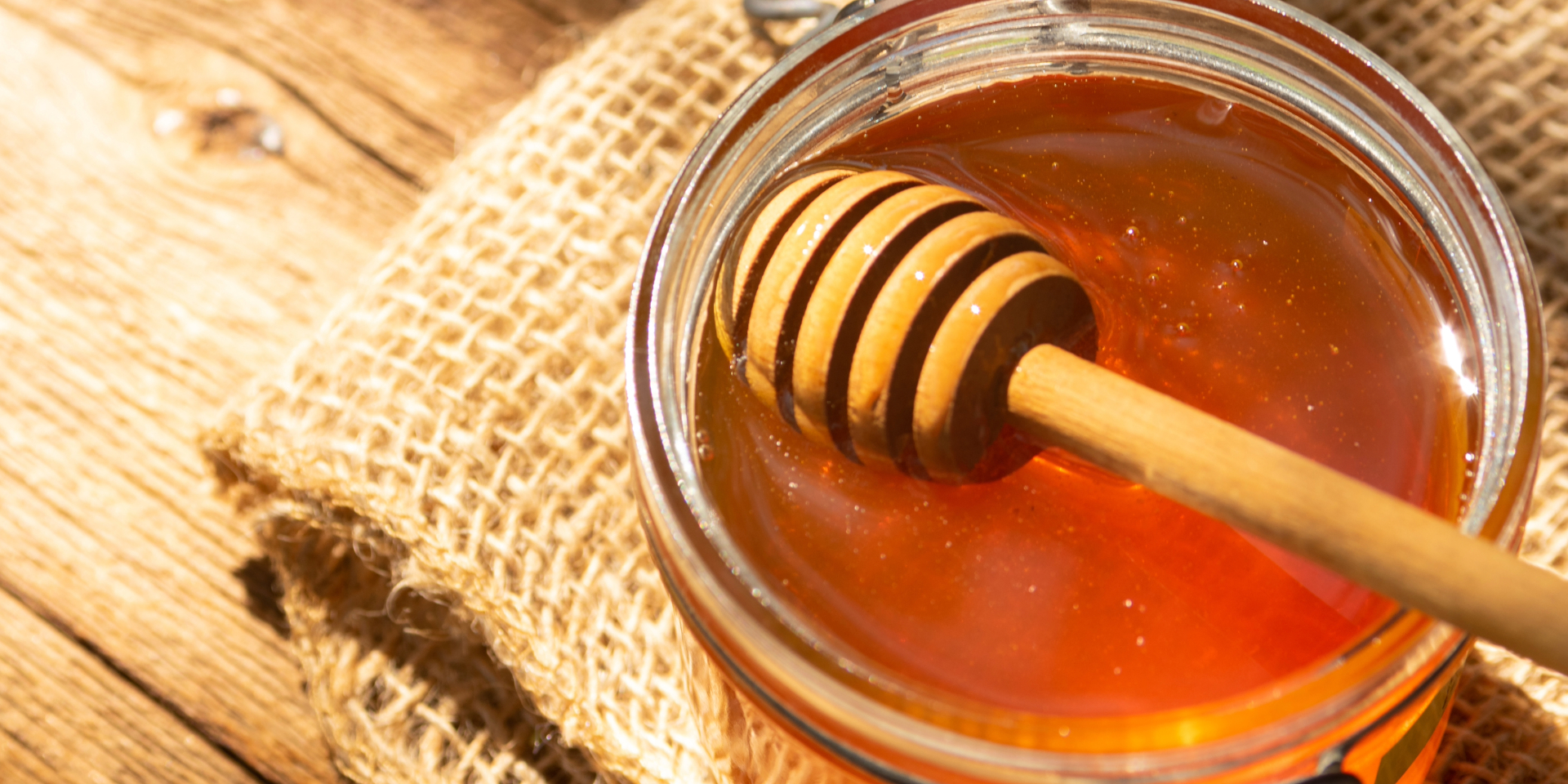
Honey has a highly complex chemical composition that varies depending on the botanical source from which bees collect nectar. Throughout history, it has been valued both as a food and as a medicine.
Myth: Honey is nothing more than “liquid sugar.”
Honey is the result of the complex transformation of nectar collected by bees from flowering plants. Nectar is composed primarily of water (80–95%) and sucrose (5–20%). Inside the hive, an enzyme in the bees’ digestive system called invertase breaks down the sucrose into fructose and glucose. As the honey matures, the bees fan their wings to evaporate water from the nectar, gradually turning it into the thick, concentrated substance we know as honey. This reduction in water content, together with honey’s acidic pH (approximately 3.2 to 4.5), inhibits the growth of microorganisms, which require moisture to survive and multiply. As a result, honey naturally preserves itself and requires no added preservatives to maintain its properties over long periods.
In addition to fructose and glucose, honey contains a wide range of other beneficial compounds. Although oligosaccharides are among its predominant components, honey also contains amino acids, vitamins, minerals, and enzymes, the amounts of which vary depending on the diversity of the flowers visited by the bees. Nearly all natural honey contains antioxidants such as flavonoids and phenolic acids, along with essential compounds including ascorbic acid, tocopherols, and antioxidant enzymes—catalase (CAT), superoxide dismutase (SOD), and reduced glutathione. Together with Maillard reaction products and various peptides, these compounds act synergistically to enhance honey’s antioxidant properties (Alvarez-Suarez, Tulipani et al., 2010; Johnston, Sepe et al., 2005; Turkmen, Sari et al., 2006; Rakha, Nabil, and Hussein, 2008; Al-Mamary, Al-Meeri, and Al-Habori, 2002).
Honey has long been recognised as the preferred natural sweetener because of its higher fructose content—it is about 25% sweeter than table sugar (Babacan and Rand, 2007; Pataca, Borges Neto et al., 2007). Today, researchers continue to investigate honey’s precise composition and its potential health benefits. The accumulated evidence suggests that honey has a positive effect on human health, with studies highlighting its antioxidant (Ahmed and Othman, 2013), anti-inflammatory (Khalil, Moniruzzaman et al., 2012), antibacterial (Attia, Gabry et al., 2008), antidiabetic (Estevinho, Pereira et al., 2008), and gastrointestinal health-supporting properties (Abdulrhman, El-Hefnawy et al., 2011). In addition, honey appears to contribute to cardiovascular protection and the healthy functioning of the nervous system (Ghosh and Playford, 2003).
The fructose and glucose in honey are present in their free form, which may allow them to be metabolised differently from the sucrose found in table sugar and may contribute to a slower rise in blood glucose levels. Honey has an average glycemic index (GI) of about 55, compared with approximately 68 for table sugar. The glycemic index measures how quickly a food raises blood sugar levels after consumption. A lower GI indicates a slower, more gradual effect on blood glucose. Even so, honey’s calorie content and density must also be taken into account. Although honey contains fewer calories per gram than sugar—304 kcal per 100 g compared with 392 kcal per 100 g—its greater density means that a tablespoon of honey weighs more and therefore contains more calories than a tablespoon of sugar (68 kcal versus 49 kcal).
It is essential to remember that, although honey may offer certain advantages because of its lower glycemic index and unique composition, it is still high in sugars and should therefore be consumed in moderation. The World Health Organization recommends that, for additional health benefits, free sugars account for less than 5% of total daily calorie intake. Moreover, honey is not recommended for children under one year of age because of the significant risk of infant botulism, which can occur through the ingestion of Clostridium botulinum spores that may be present in honey.
Bibliography
- Abdulrhman, M., El-Hefnawy, M., et al. (2011), “Honey and type 1 diabetes mellitus”, in Liu, C. P. (ed.), Type 1 Diabetes – Complications, Pathogenesis, and Alternative Treatments, In Tech, Rijeka, pp. 423–436.
- Ahmed, S., și Othman, N. H. (2013), “Honey as a potential natural anticancer agent: A review of its mechanisms”, in Evidence-based Complementary and Alternative Medicine, vol. 2013, art. no. 829070.
- Al-Mamary, M., Al-Meeri, A., and Al-Habori, M. (2002), “Antioxidant activities and total phenolics of different types of honey”, in Nutrition Research, vol. 22, no. 9, pp. 1041–1047.
- Alvarez-Suarez, J. M., Tulipani, S., et al. (2010), “Contribution of honey in nutrition and human health: A review”, in Mediterranean Journal of Nutrition and Metabolism, vol. 3, pp. 15–23.
- Attia, W. Y., Gabry, M. S., et al. (2008), “The anti-tumor effect of bee honey in Ehrlich ascite tumor model of mice is coincided with stimulation of the immune cells”, in The Egyptian Journal of Immunology, vol. 15, no. 2, pp. 169–183.
- Babacan, S., and Rand, A. G. (2007), “Characterization of honey amylase”, in Journal of Food Science, vol. 72, no. 1, pp. C050–C055.
- Estevinho, L., Pereira, A. P., et al. (2008), “Antioxidant and antimicrobial effects of phenolic compounds extracts of Northeast Portugal honey”, in Food and Chemical Toxicology, vol. 46, no. 12, pp. 3774–3779.
- Ghosh, S., și Playford, R. J. (2003), “Bioactive natural compounds for the treatment of gastrointestinal disorders”, in Clinical Science, vol. 104, no. 6, pp. 547–556.
- Johnston, J. E., Sepe, H. A., et al. (2005), “Honey inhibits lipid oxidation in ready-to-eat ground beef patties”, in Meat Science, vol. 70, no. 4, pp. 627–631.
- Khalil, I., Moniruzzaman, M., et al. (2012), “Physicochemical and antioxidant properties of Algerian honey”, in Molecules, vol. 17, no. 9, pp. 11199–11215.
- Pataca, L. C., Borges Neto, W., et al. (2007), “Determination of apparent reducing sugars, moisture and acidity in honey by attenuated total reflectance-Fourier transform infrared spectrometry”, in Talanta, vol. 71, no. 5, pp. 1926–1931.
- Rakha, M. K., Nabil, Z. I., and Hussein, A. A. (2008), “Cardioactive and vasoactive effects of natural wild honey against cardiac malperformance induced by hyperadrenergic activity”, in Journal of Medicinal Food, vol. 11, no. 1, pp. 91–98.
- Turkmen, N., Sari, F., et al. (2006), “Effects of prolonged heating on antioxidant activity and colour of honey”, in Food Chemistry, vol. 95, no. 4, pp. 653–657.