








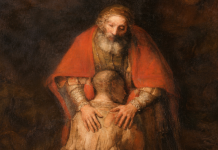



“For we are God’s handiwork, created in Christ Jesus to do good works, which God prepared in advance for us to do” (Ephesians 2:10).
“Christ in His life on earth made no plans for Himself. He accepted God’s plans for Him, and day by day, the Father unfolded His plans… Too many, in planning for a brilliant future, make an utter failure. Let God plan for you… God never leads His children children otherwise than they would choose to be led, if they could see the end from the beginning, and discern the glory of the purpose which they are fulfilling as co-workers with Him.”[1][2][3][4]
A teacher was once reprimanded by a close friend for speaking sloppily, even ungrammatically, in a private conversation. He defended himself by saying that speaking properly at school was hard enough, and that he could afford to relax in private. It was as if his professionalism were simply a mask he put on, rather than being part of who he was. For a teacher like that, correct speech risks becoming nothing more than a uniform or a shop window. Isn’t the Christian of today in the same danger, living out their faith as a mere façade? The reflections below have emerged over the years in my spiritual life.
Deeds are born of attitudes and values
Our attitudes are states of mind that lie on the border between thoughts, feelings, and actions. We aren’t acting yet, but our thoughts and feelings are already shaping a certain disposition, a leaning that can be positive, negative, or neutral. Attitudes can show either openness, involvement, and enthusiasm, or withdrawal, rejection, indifference, and inertia.
When it comes to forming character, shaping our attitudes is essential because they provide a glimpse of future actions. By educating our attitudes, we can predict our behaviour, prevent mistakes, and encourage the right actions. This is achieved by promoting values such as goodness, truth, beauty, justice, compassion, and solidarity, which give life meaning and a longing for fulfilment and eternity. Christian values remain the most fitting framework for all of this.
Our attitudes are gradually shaped at any age by accepting God’s teachings. A Christian’s duty is to seek God in the Word, in life and in creation, and to allow Him to mould us as a pupil would entrust themselves to their master. This teaching is not separate from everyday life. It is lived out in our daily lives, in our service, and in our worship.
As one teacher put it, an authentic Christian life cannot fluctuate or waver; it must be consistent. It requires consistency and unity between thought, word, and deed, in other words, integrity. We all stumble and have our weaknesses, but we should keep heading in the right direction, fighting the old self, holding on to hope in God’s justice and forgiveness, and drawing closer to Christ, the supreme example. These values and attitudes are evident in the lives of those who grow to be like Christ and recognise one another wherever they are. It is wonderful how alike His children are, wherever they live.
As we grow in our knowledge of and obedience to God’s will, we are in fact fulfilling our duty as Christians: to perform the good works that God prepared in advance for us, rather than those we have planned ourselves. However, this kind of consistency isn’t the fruit of human willpower. It comes from a living relationship with God, in which the soul is nourished by Him.
The food and breath of the soul
In prayer, the “law of communicating vessels” is real: when we carry other people’s burdens, God looks after ours. It teaches us to see prayer as living communion with God, marked by gratitude, repentance and specific requests, by selflessness and trust, rather than by complaint and self-pity. Sometimes, we don’t receive the answer we want because we are praying for our former selves, asking for the removal of trials that are actually intended to help us grow, gain wisdom, and achieve victory.
It is this expansion of our prayers beyond ourselves that calls us to intercede not only for our families and loved ones, but also for the important causes in our communities. We must remember that the revival of Christian churches, which is so desperately needed today, begins with prayer.
In this way, we learn to recognise the Saviour’s voice, follow Him and rediscover the freshness of Scripture as our one powerful defence in a hostile world. Its words have not lost their force. It is only our own perception that has grown dull. Consider this promise, for example: “And surely I am with you always” (Matthew 28:20). What does it tell us? That we should be with Him because He is already with us! So, my wish for you is this: God with us and us with Him! Then there is Paul’s call to “take captive every thought to make it obedient to Christ” (2 Corinthians 10:5). This requires constant mental hygiene: any thought that we know is not pleasing to Him should be turned straight into a prayer so that it cannot breed monsters. Here is another example. What are we told by the fact that joy is one of the fruits of the Spirit (Galatians 5:22) and that Christ’s love “surpasses knowledge” (Ephesians 3:19)? Are we not urged to live life to the full through His love rather than dwell on cold theology?
“The fear of the Lord is the beginning of wisdom” (Psalm 111:10). This fear is not terror, but rather a profound respect for the transcendent. When that respect fades, we are tempted, like Lucifer, to look down on the world from above. Relationships become superficial and are taken over by pride and artificial hierarchies at the expense of genuine bonds. This is why communities built on humility have cultivated closeness and brotherly love rather than rank.
The healing of our spiritual life begins with humility, from which gentleness, patience, empathy, and solidarity can flow. A lack of immediate results should not discourage us because change is the work of the Holy Spirit; our part is to remain faithful and maintain our moral integrity.
Heavenly citizenship is something very practical: a kind of training for heaven that helps us distinguish between what is and isn’t worth valuing and taking in. At every step, we should ask ourselves: does this align with heavenly citizenship? This helps us to make informed choices in our daily lives, not to earn an official “diploma”, but to align our beliefs and actions. At the same time, it generously opens up the way for those around us to grow.
Corina Matei offers a few reflections on a genuine Christian life, free from showmanship. These reflections have been shaped by the example of people around her who are role models for others, and above all by the transformative power of the Gospel.