











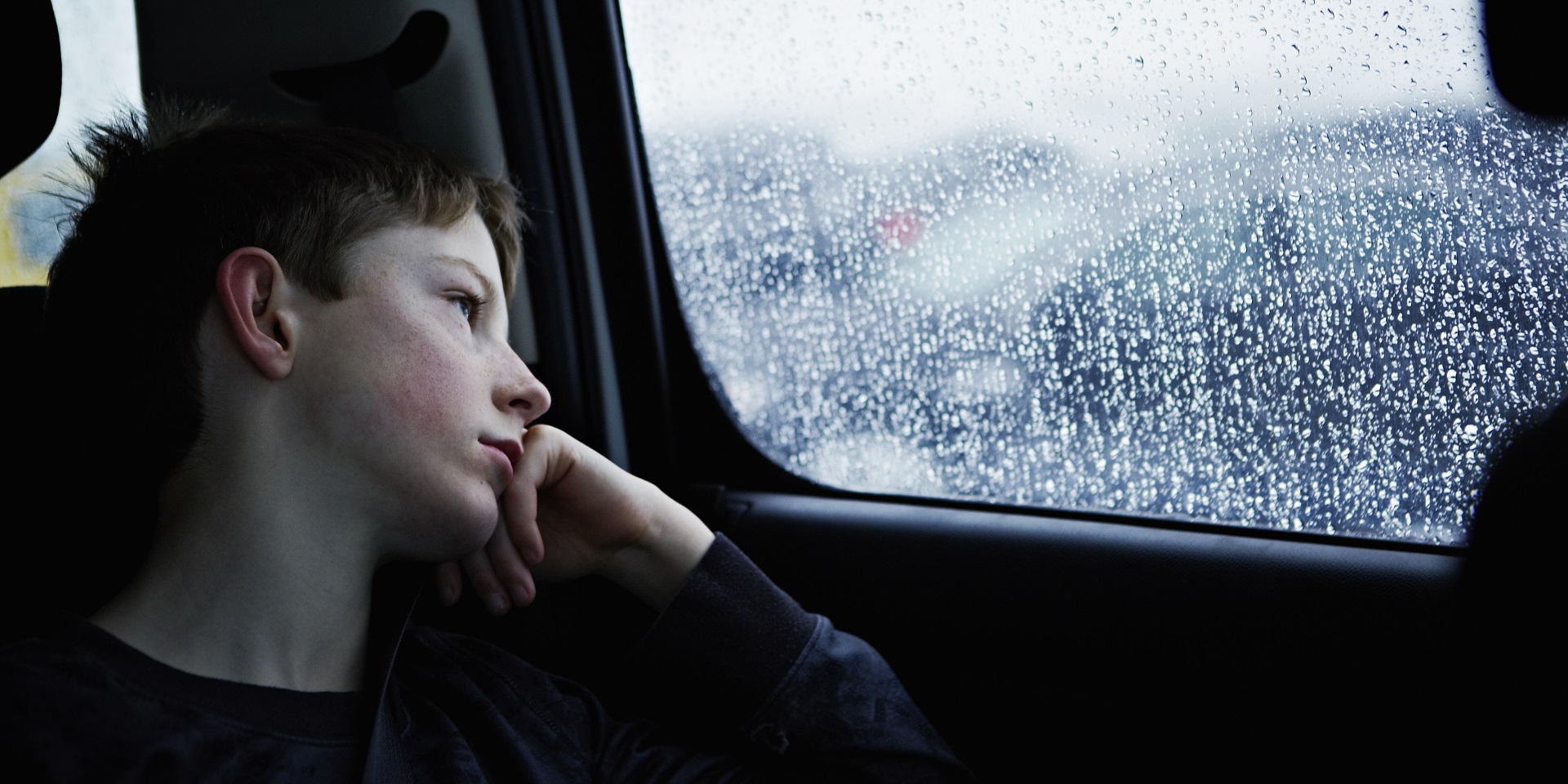
“My sadness hears the unborn dogs / barking at the unborn people” (Romanian poet Nichita Stănescu).
The word “sad has a remarkably long history. Its form has changed very little from its Indo-European root (tréystis) to its descendants in Latin- and Germanic-language families. From the Old Saxon thristi to the Dutch drijst, from the Latin tristis to the Venetian tristo, the same word has traveled across countries and cultures. Similar forms also appear in Catalan, Old Irish, Old French, Welsh, Danish, Swedish, Norwegian, Piedmontese, and other languages. In Sicilian, tristu can also mean “evil” or “maleficent.”
These linguistic connections point to the widespread, everyday use of the word—as though it were a universal currency. The same cannot be said of its antonyms, such as happy, joyful, or cheerful. Why is it that this particular linguistic and cultural “currency” never needed to be exchanged for local equivalents?
A universal human experience
Since antiquity, it has been believed that every human being is destined to experience, over the course of life, the full range of emotions and feelings available to our nature. The ancient playwright Terence is often quoted as saying, “I am human, and nothing human is alien to me.”
When we examine human emotions and feelings, we encounter a paradox. On the one hand, they are unique and deeply personal, born within each individual and impossible to share with someone else in exactly the same way. On the other hand, they can be named, described, and turned into linguistic “currencies” of universal circulation, just like all other concepts.
Some theorists have drawn up a list of the six most common human emotions: sadness, happiness, disgust, surprise, anger, and fear. And although such a list immediately gives the impression of a drastic reduction, an oversimplification of the complexity of human emotional life, it is still striking that four or five of the six are negative emotions, including sadness. In other words, the emotional map of human experience appears to be predominantly negative. Moreover, when an emotion—which is typically short-lived and intense—becomes chronic, it turns into a feeling, less intense but much longer-lasting, and can even come to characterise a person’s personality.
Yet in culture, sadness stands apart from the other emotions as the most fertile and inspiring source for artistic creation, philosophy, and various forms of theoretical and scientific discourse. In every era and every country, one can find this common thread of sadness, sorrow, anguish, and melancholy: from the Latin poet Ovid to the Spanish writer Miguel de Cervantes, from the Danish philosopher Søren Kierkegaard or the French psychologist Théodule Ribot to Russian writers such as Nikolai Gogol, Anton Chekhov, Fyodor Dostoevsky, and Vasily Shukshin, as well as the German novelist Thomas Mann or the Swiss art critic Jean Starobinski.
The list is vast—virtually endless. Countless masterpieces of world art convey deeply personal perceptions of this universal human experience of sadness, preserved like a rare fragrance whose scent lingers across the centuries. From the blues of enslaved African Americans to the melancholy that defined the fin de siècle; from the paintings of Vincent van Gogh to the Portuguese Letters; from the haiku written by Japanese poets before taking their own lives to the poems of John Keats, Edgar Allan Poe, and Romanian poet Mihai Eminescu; and to the melancholy emblem of the entire Romantic movement (“O my blue flower, my blue flower! The world is sorrow everywhere”).
Our own era has also produced remarkable works that sublimate sadness: the lyrical, literary, and cinematic universe of Bonjour Tristesse; “Lead” by Romanian poet George Bacovia; and the many poems and films titled “Melancholy”. Together, these works make sadness a source of inspiration and productive solitude, especially in the face of death, illness, the loss of love, freedom, youth, or innocence.
Romanian poetry offers a striking example in the closing lines of Tudor Arghezi’s love poem “Melancholy”. The lover waits for his beloved in an enchanting nighttime setting, yet his thoughts and feelings while waiting become more familiar and more profound than the joy of seeing her again: “And now, as I see her coming / along the lonely path, / from afar I feel a longing / and almost wish it were only an illusion.”
All these cultural landmarks clearly suggest that sadness can become far more than a passing emotion. It can be transformed into something extraordinary: the negative into the positive, inner darkness into dawn, silent and unseen suffering into a swan song. This is what distinguishes sadness from other emotions and feelings—its unique capacity to be transformed into something good and beautiful.
From sadness to hope
More often than not, however, in the prose of everyday life, the heroic effort to transform sadness into something good, noble, and uplifting is doomed to fail. To this day, the verses from “Tristia” (“Sorrows”) by the Roman poet Ovid continue to resonate with unsettling power. Banished by Caesar to die alone, helpless, misunderstood, and unforgiven in the barbarian port city of Tomis, he wrote: “What else to try for ills so bad? If I look at the place, it’s most unlovely and nothing in the world can be more sad.”
These despairing lines were written in AD 10. Seven years later, Ovid died—ill, heartbroken, and without hope—among tribes known only for violence, plunder, enslavement, murder, and human sacrifices offered to pagan gods.
Reading what has survived of Ovid’s anguished writings, it is difficult not to shudder at an imagined version of history in which Jesus Christ had never been born as the Saviour. For sadness lays claim to a realm of captivity so vast and so familiar within the human heart that it transcends differences of culture, language, and tradition. Sadness has been with us for as long as humanity itself.
From this perspective of an alternative history—one in which there had been no escape and no salvation—we might imagine that some people, through extraordinary heroism, would have managed to overcome the darkness of sadness and even create remarkable works capable of bringing some measure of comfort to others, to those who lacked the refuge of creativity. Yet without the hope of one day escaping forever from the confines of that dark realm, sadness would still have reigned supreme over every other emotion and feeling, much like the image evoked by the Romanian poet Mihai Eminescu: “This world of life is merely a dream of Death eternal.” The echo of Edgar Allan Poe’s raven would have become the refrain and epitaph for everything good that passes away forever: “Nevermore!”[1]
Among the gifts that the Saviour has given to this world overshadowed by darkness is the remedy for sadness. The Bible contains many promises that bring comfort to the troubled soul, but one, repeated near its conclusion, reveals just how deeply He is involved in our consolation. It also shows that sadness will be the last negative emotion to be transformed into experiences of peace, joy, healing, and gratitude: “For the Lamb at the center of the throne will be their shepherd; ‘he will lead them to springs of living water.’ ‘And God will wipe away every tear from their eyes’” (Revelation 7:17).
Although tears are also a physiological function of the human body, they retain an element of mystery that has yet to be fully understood. There are three distinct types of tears: those that continually moisten the eyes; those produced in abundance to wash away occasional irritants; and emotional tears, which are unpredictable and differ from the others in their chemical composition. If God’s promise to His children is that He Himself will wipe away their tears, then this is evidence of a relationship with the Saviour that is real, direct, warm, and personal. Tears arise from the experiences of a soul; they are individual, not collective or impersonal.
That will be the moment when sadness is finally healed—when all human suffering, from the foundation of the world onward, or, as the Roman historian Livy put it, ab urbe condita[2] receives its restorative and ennobling consolation.
Japanese culture preserves a technique for rescuing precious broken vessels from destruction by joining the fragments together with an adhesive coated in gold leaf—a process that makes them even more beautiful and valuable than they were before they broke. Something similar happens when a person chooses—sometimes only after a dramatic struggle with self, with evil, and with a hostile world, yet always beneath the promise of God’s salvation—to transform painful experiences into gold; to gather the fragments of a broken heart and give them greater worth than they possessed before the “lesson” of those experiences.
Let us not forget that the Giver of this transforming gold—the gold refined by fire (Revelation 3:18)—is the same One who created the precious vessel of our hearts. Let us work together with Him in restoring our souls, and with His help move beyond the final age of sadness in this world.
But let us also remember that we, too, can wipe away the tears of our Saviour (John 11:35), and that we can spare Him the deepest and most immeasurable sorrow of all: grieving the Holy Spirit (Ephesians 4:30).
Corina Matei explores the linguistic and cultural spread of the word “sad,” as well as the social dimensions of sadness. Their remarkable universality, enduring relevance, and great antiquity point, in many ways, to the very age of humanity itself.