











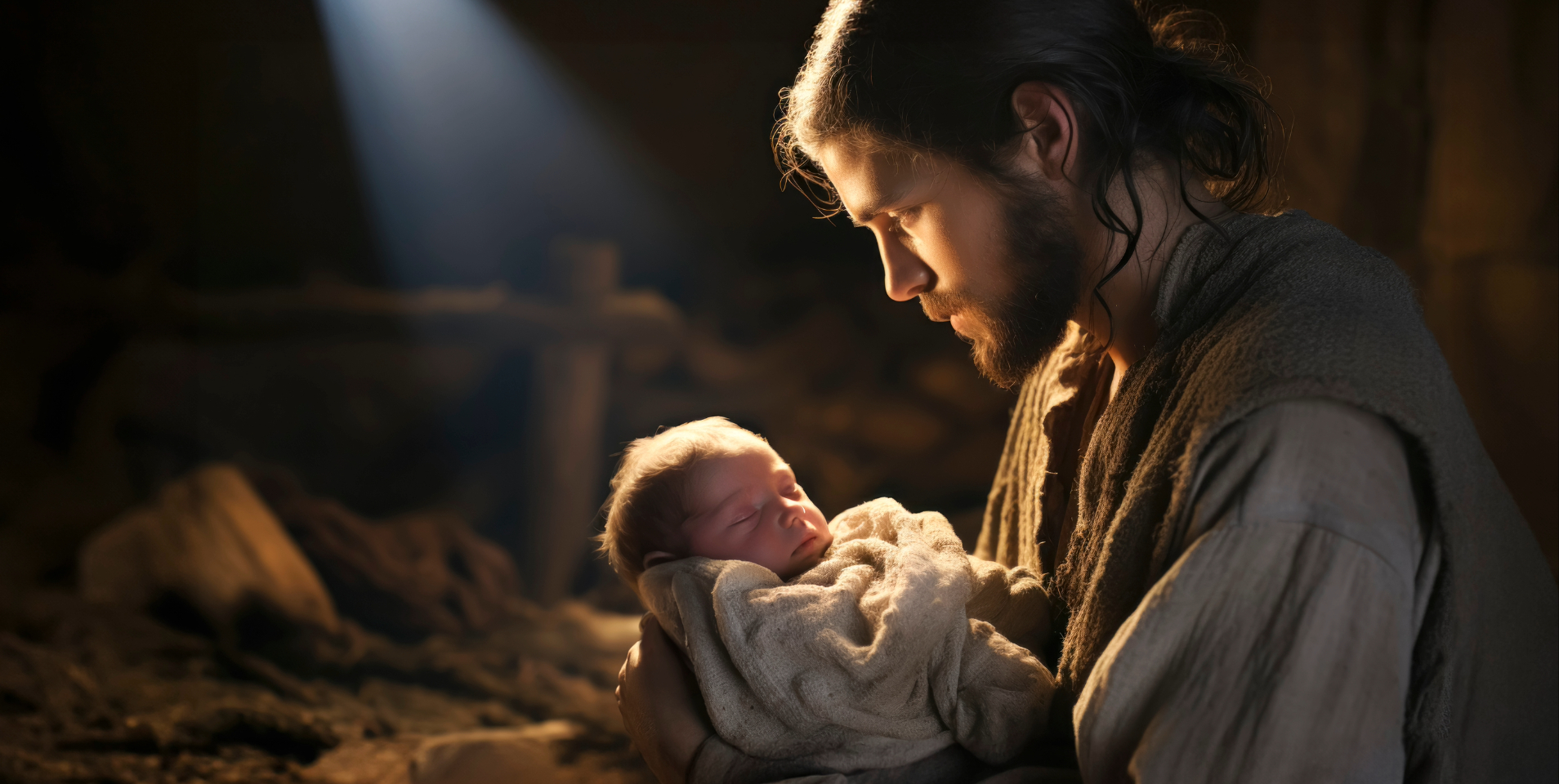
In the history of salvation, few people have received a more unsettling calling than Joseph of Nazareth. After overcoming his initial hesitation, he made a series of decisions born of obedience. He remains a model of mature faith and authentic manhood.
In biblical tradition, betrothal was not just a promise, but a legally binding commitment. It usually lasted for a year before the actual marriage. During this period, the couple were required to maintain strict marital fidelity. Any infidelity was considered adultery and punishable by death by stoning (Deuteronomy 22:23–24).[1]
Joseph’s dilemma
In a world of rules and hasty condemnation, Joseph—the last in a line of remarkable ancestors (Matthew 1:1–16)—learns that his fiancée is pregnant. Joseph was a righteous man, meaning he strictly observed the Law. Given the circumstances, he could not agree to marry Mary, but he also did not want to expose her to public shame. Therefore, he intended to break off the engagement discreetly—only two witnesses were needed.[2]
However, the explanation for Mary’s pregnancy points to a divine act of creation: the child is conceived “from the Holy Spirit” (Matthew 1:20). The divine agent of life (Genesis 1:2) could bring the life of the Son of God into existence in Mary’s womb without the intervention of a man.[3] Furthermore, Joseph knows Mary. He knows that she is an honourable woman who fears God (Proverbs 31:10, 30). So, it could be true! Joseph, a man of the Law, is now torn between faith and duty, fearing the spiritual and social consequences of his decision.
Obedience
Joseph had settled on the obvious solution to the dilemma, though he wanted to minimise the negative consequences for his fiancée. In the first century, the death penalty by stoning for adultery was no longer in force; the Roman authorities had banned these executions.[4] In this context, a discreet divorce seemed the most appropriate course of action.
The pressure that Joseph was under when making this decision has preoccupied biblical commentators throughout the ages. According to an anonymous fifth-century author, Joseph suspected that Mary’s pregnancy might be God’s doing and feared bringing any public accusation against his fiancée. In his view, it was better for a guilty person to escape justice than for an innocent person to suffer.[5]
However, Joseph’s hesitation is resolved when God intervenes, overturning his plan to withdraw and revealing the truth about Mary’s pregnancy. An angel appeared to him in a dream and said, “Joseph son of David, do not be afraid to take Mary home as your wife, because what is conceived in her is from the Holy Spirit. She will give birth to a son, and you are to give him the name Jesus, because he will save his people from their sins” (Matthew 1:20–21).
Thus, Mary’s words are confirmed. The angel calls Joseph “son of David,” again referring to lineage and divine election. Of all David’s descendants, Joseph is “son of David” not only by blood, but also by readiness.
But how can Joseph pass on the royal inheritance to a child who is not his son according to the flesh? Jesus’s belonging to the lineage of David cannot be questioned, as His mother Mary is also of the lineage of David.[6] But Joseph confers on Jesus the right to be the messianic king by assuming legal paternity, an act accomplished by naming Him. “I have summoned you by name; you are mine” (Isaiah 43:1). By doing so, Joseph recognises divine authority and becomes a partner in God’s plan. He understands that Jesus is the heir to David’s throne,[7] but in a much higher sense.
Joseph joyfully obeys: “When Joseph woke up, he did what the angel of the Lord had commanded him and took Mary home as his wife. But he did not consummate their marriage until she gave birth to a son. And he gave him the name Jesus” (Matthew 1:24–25). Taking concrete actions at the right time is more important than anything else: Joseph woke up, took Mary as his wife, and at the right time named the child Jesus. Through his obedience, the Messiah entered history with all His prerogatives. Thus, Joseph publicly confesses two essential truths: that Jesus is “the Son of David” and that He is of divine origin.[8] Under other circumstances, a righteous Jew like Joseph would not have accepted such a situation. The detail that “he did not have intercourse with her until she had given birth” again proves Joseph’s complete conviction that Mary’s pregnancy was the work of the Holy Spirit.[9]
Obedience to God does not diminish Joseph; it elevates him in grace. Through this obedience, he truly becomes “the son of David”, Mary’s husband, and a participant in an unparalleled Father–Son relationship.
A role model for men
When faced with an impossible situation, Joseph’s response is not to flee, but to open himself to God’s plan. Faced with a trial, he does not retreat but activates all his inner resources and all that is noble in his being unreservedly and uncompromisingly.
Joseph remains an exceptional model for men of all times: as a husband, he protects without a trace of jealousy; as a father, he educates by example, not fear; and as a man of God, he obeys unconditionally.
He is memorable not for his words, but for his willingness to carry impossible burdens: servant of the Nativity, protector of the Child, support of his wife, teacher of the King of kings, father to the Son of God, and witness to the incarnate Godhead. How could he have accomplished all this if he had not relinquished his desire for control in favour of God?[10]
Andrei Bogdan examines the role played by Joseph in the story of the Messiah’s birth, highlighting how his obedience to God places him in a unique relationship with his son and transforms him into an example of faith.