











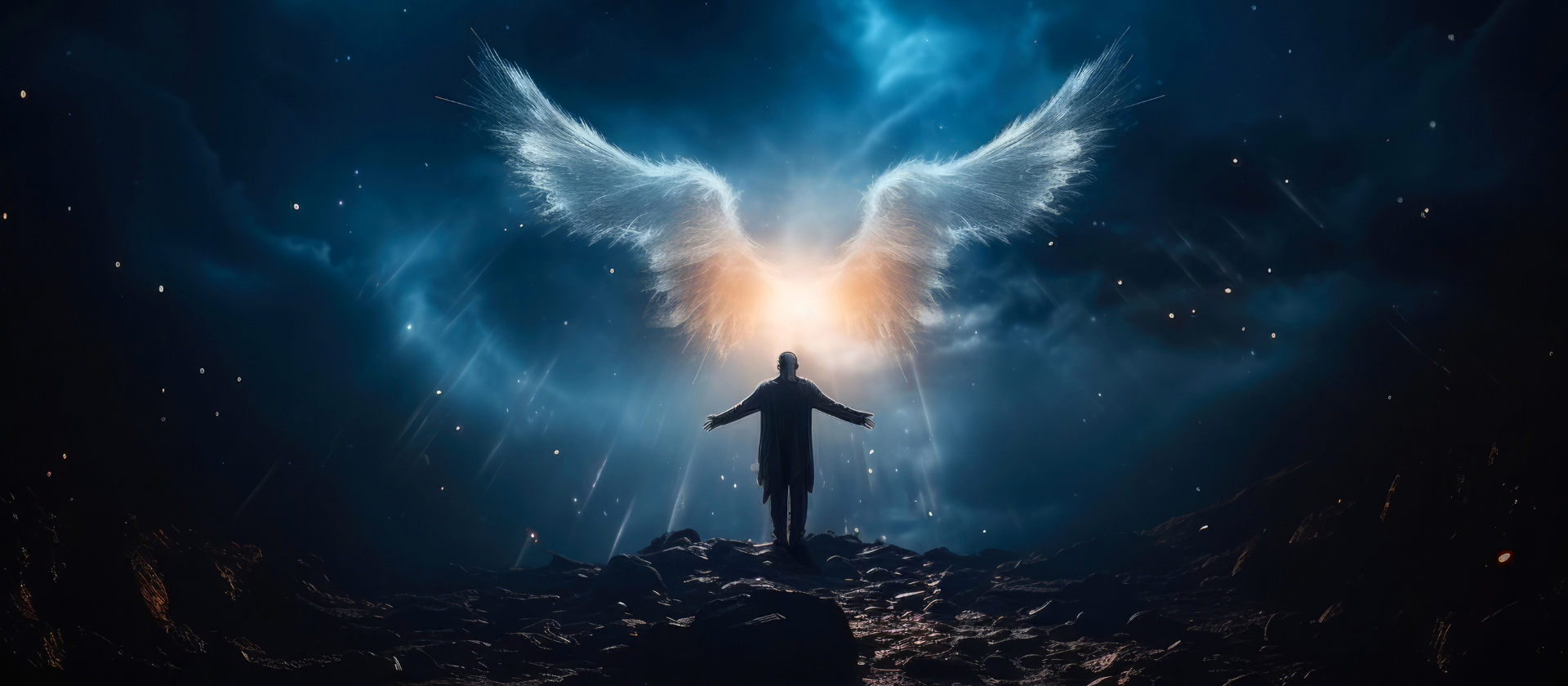
No scene depicting the birth of Jesus is complete without angels.
Whether cheerful or serious, dressed in gold or light, angels are easily recognisable by their large wings, long white robes, and halos of glory floating gently above their heads, as depicted in traditional decorations and images. We can hardly imagine angels any other way. This may be why Andrei Pleșu begins his discussion of angels by stating that he has never encountered one.[1]
Angels appear explicitly several times in biblical scenes related to the birth of Jesus. It is said that Joseph received three messages from God through an angel, each time in the same way: “in a dream” (see Matthew 1:20; 2:13, 19). No details are given about the angel’s appearance, but when Joseph saw him in a dream, he recognised him and accepted his message, even though it was beyond his understanding.
The angel of the annunciation
In the accounts of the evangelist Luke, a single angel is sent to deliver an important message: first to Zechariah, the priest, and then to Mary, who was betrothed to Joseph at the time.
While Zechariah was serving in the temple’s first chamber, “an angel of the Lord appeared to him” (Luke 1:11). No mention is made of wings, a halo of glory, or white robes, only that the priest was terrified and almost froze with fear in his presence. To reinforce his message to Zechariah, who was sceptical about the news that his prayer had been heard, the angel did something unusual—he introduced himself: “I am Gabriel. I stand in the presence of God” (Luke 1:19). It would seem paradoxical that a priest who entered the temple to ask for God’s mercy on the people would doubt that it could also come upon him. Not even the angel’s revelation of his identity and special position convinced Zechariah that what he was seeing and hearing was real. Consequently, the angel was compelled to provide a sign that would be unforgettable for Zechariah and his loved ones: “And now you will be silent and not able to speak until the day this happens” (Luke 1:20).
The same angel visited Mary a few months later. This time, he did not feel the need to introduce himself, but the inspired author tells us from the outset that it is the angel Gabriel. The angel greeted Mary politely and told her that she had found great favour, a favour that would bring her joy, humility, pain, and fulfilment, and tears of sorrow and happiness. Mary, who had never seen an angel before, believed his words with impressive modesty: “I am the Lord’s servant. May your word to me be fulfilled” (Luke 1:38).
However, this is not the first time we hear of an angel with this name. The Book of Daniel refers to “Gabriel, the man” (Daniel 9:21), which suggests that this heavenly being did not have the wings and halo that medieval and modern church painters have depicted him as having.
It would also be remiss not to mention that angels appeared for the last time in connection with the birth of Jesus on a quiet night in the hills of Bethlehem. This time, it was not just one person who saw an angel, but several shepherds who were “keeping watch over their flocks at night” (Luke 2:8). The shepherds had the privilege not only of seeing and hearing an angel, but also of witnessing a spectacle unlike anything else in history—”a great company of the heavenly host appeared with the angel, praising God” (Luke 2:13). Words cannot describe the grandeur of such a hymn, which those anonymous shepherds heard that night.
We can safely assume that it was probably the same angel in all these scenes: the one who stands “before the Lord”, as Lucifer once did, and who was entrusted with the honour of announcing to the world the coming of the Messiah, for whom they had waited for centuries.
Angels of hope
Although it is not easy for us, we can imagine the amazement, fear, or enthusiasm of those who had the privilege of meeting in person the angel standing closest to God’s throne. The question is, what was it like for the angel to interact with people?
Perhaps he was delighted by the faith of Joseph, Mary, or the shepherds, or surprised by Zechariah’s unbelief, or the fact that although he and his companions could have sung to all the inhabitants of Bethlehem, only a few simple shepherds were willing to listen and follow their instructions.
The Bible presents angels as “ministering spirits sent to serve those who will inherit salvation” (Hebrews 1:14), with abilities that exceed anything we could imagine or know. However, when interacting with humans, they refused any form of worship, saying that they are “fellow servants” (Revelation 19:10; 22:9) with humans. This is why all worship is due to God alone.
In the Bible, the appearance of angels is so common that some have come to host them “without knowing it” (Hebrews 13:2). This suggests, to paraphrase the ancients, that it is not their wings that define angels, but their relationship with God and the mission He has entrusted them with for humanity.
The story of the angel Gabriel is not about his incredible powers or his ability to persuade, but about a God who sent one of his most important heavenly servants to bring a message of hope to the humblest of people. These people, who “were overjoyed” (Matthew 2:10)[2], believed Gabriel and spread the glory and peace that heaven wanted to pour into everyone’s hearts on that day.
Although certain passages of the Bible depict heavenly beings with two or even six wings, none of the angels who came to deliver messages are described as having wings. They would not have needed them either, as they could move in other ways. For example, regarding the angel who announced the birth of Samson, it says: “As the flame blazed up from the altar toward heaven, the angel of the Lord ascended in the flame. . . Manoah realized that it was the angel of the Lord” (Judges 13:20–21). Andrei Pleșu was right when he observed: “As symbols of divine proximity, angels are the privileged ‘medium’ of revelation and the ‘instruments’ of divine manifestation. . . Angels are close to God because they are the only created beings who can endure being in His proximity. . . But angels are also mankind’s ‘immediate neighbour’. They are our ‘heavenly friends’, our tireless teachers, guides, and protectors. Through their discreet intervention, ‘guardian angels’ strive to counterbalance the devil’s seduction.”[3] This closeness does not replace the mediation of Christ or the work of the Holy Spirit, but brings them closer to people in need of forgiveness and guidance. It is not in place of God, but at His command.
That is precisely why I don’t wonder whether I have ever seen an angel, but whether I recognised them every time I encountered one. I know for sure, however, that the angels have never mistaken us for anyone else.
Adrian Neagu invites us to accompany the angel who announced Jesus’ birth on a journey into the world of His arrival, in order to gain an in-depth understanding of the mission of angels and their role in fulfilling the divine plan.