











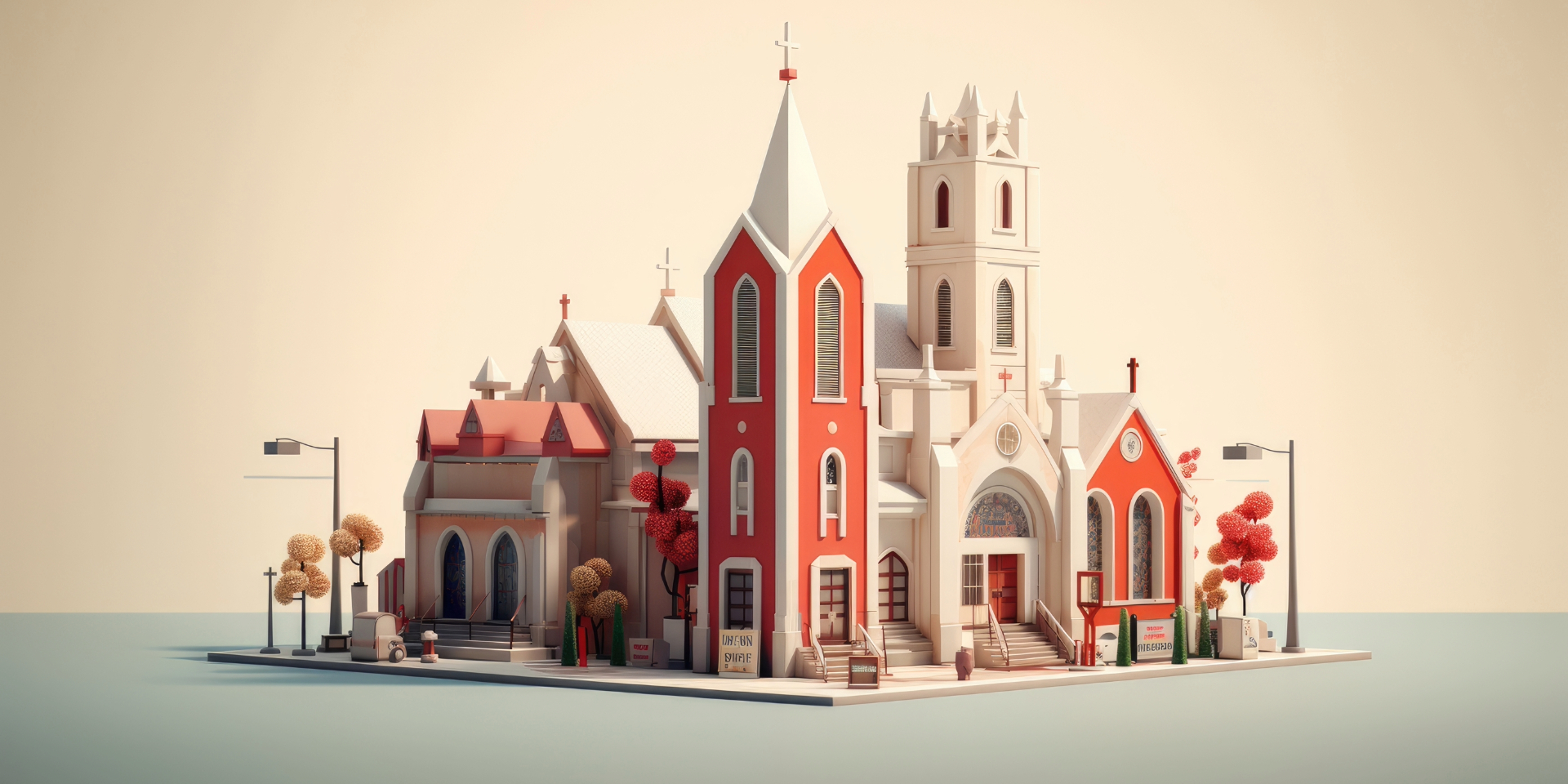
Founded on the separation of political and religious authority and shaped by the presumed liberating power of reason, contemporary society is driven by faith in progress as a substitute for faith in God. At the heart of this secularized world, a pressing question emerges: what role does the Church still play today?
As early as the sixteenth century, a series of cultural and political factors led to the rise of what came to be known as “secularization,” a process through which society gradually reduced the Church’s sphere of influence. Until then, religion had been regarded as the supreme science, subordinating all other fields of knowledge. As the relationship between society and the Church shifted, religion’s domain was steadily narrowed. Secularization brought with it a dilution of moral and religious values—values that, until not long ago, were seen as sources of social cohesion. Today, modern society seeks cohesion instead through civic values and political ideals. Its structure has acquired a strongly subjective character and now appears to dominate the very people who originally created it.
European society was built largely around two poles that, over time, became traditions: Christianity and humanism. Modern Europe no longer fully recognises either. Although it did not originate in Europe, Christianity played a major role in shaping the continent’s ideological unity. Today, Christianity is valued mainly as cultural heritage, as the interests of postmodern individuals have shifted in entirely different directions under the heavy pressure of secularization—a force that has privatized religion and gone so far as to remove Christianity almost entirely from the public sphere. Both the humanist aesthetic and philosophical vision of affirming the “great universal ideas of humanity” and proclaiming the “nobility of the human being through the cultivation of the soul,”[1] as well as the Christian moral vision of life, have been replaced by postmodern pragmatism and ideological relativism.
If this is indeed the case, and if religion has become merely a private matter, confined exclusively to the personal sphere, the question returns once more: what role does the Church have today?
The architecture of Christian churches: symbol and meaning
To understand what the role of the Church and religion is today—and what it ought to be—we must first understand their role and influence in the past. This inquiry can benefit greatly from the study of architectural works, which function as genuine historical documents and provide important testimony about earlier times. Examining such documents is comparable to an archaeological investigation, with particular emphasis on the “archaeology of thought” that gave rise to these architectural forms. Since antiquity, architecture has served as an indicator of a society’s level of development and civilization, and can be seen as a barometer of the era in which it was conceived. Architecture is a social act, but also a cultural one, as it reflects the culture, traditions, and customs of the place in which it stands and of the society that created it.
Among all types of buildings, religious structures are regarded as the most significant historical landmarks. In many cultures, religion occupied a central position, which made the church the most expressive, most enduring, and most influential building within a community. In Europe, once Christianity was recognised as the official religion, buildings began to be erected specifically to house gatherings of believers and to provide an appropriate setting for worship before the Divine.
The church has always occupied a central place within the settlement in which it was built and, at the same time, a prominent place in the consciousness of the community that raised it. Whether in a rural or an urban setting, the church building was meant to be visible from afar, positioned at the heart of the settlement, sometimes even on elevated ground, to signal the presence of God in that place. In densely built medieval cities, where winding streets threaded their way between compact rows of houses, the silhouette of the church was easily recognisable, its tall spire serving as a clear landmark that usually marked the city center. Here, roads opened into a broad urban square—a public space around which the most important buildings of community life were grouped: the town hall, the princely palace, and the church.
Over time, ecclesiastical architecture underwent a series of significant transformations, both in response to changes in religious beliefs, practices, and traditions, and as a result of advances aligned with the development of construction techniques. Moreover, because the construction of these buildings often required considerable and increasingly substantial material resources, churches remained, for centuries, among the most imposing structures in the world—a kind of skyscraper of earlier eras. From the birth of Christianity to the present day, the most significant period for religious architecture was the Gothic era, which bequeathed humanity an extraordinary legacy of ecclesiastical buildings. The monumental Gothic cathedrals—true stone laceworks—such as Notre-Dame in Paris, Chartres, Amiens, or Antwerp, St. Stephen’s Cathedral in Vienna, Cologne Cathedral, or Milan Cathedral, are just a few examples that have endured through the ages.
The study of architectural structures erected over time reveals the concerns and interests of the people who built them. The central position occupied by most churches constructed between the 10th and 19th centuries, in both cities and rural settlements, reflects the place and importance of religion and faith in people’s lives. Symbolically, beyond their role as physical landmarks, churches, cathedrals, and monasteries also functioned as spiritual reference points. As true centers of worship and meditation, churches were deeply involved in religious and intellectual education, imprinting Christian moral values on the collective mindset of society.
The Church in difficulty in the 21st century
Today, churches increasingly serve the role of museums. In the 21st century, they are visited more for their architectural and artistic qualities than for the religious services held within their walls. If the church can still be regarded as a landmark, it is now primarily a cultural one, far less a spiritual reference point. Some of the remarkable church buildings inherited from the past have been demolished for various reasons, while others no longer function as places of worship. Lacking congregations and, implicitly, the funds needed for preservation, church buildings—many of them historical and architectural monuments—are being leased out and repurposed, taking on new and often surprising functions: hotels, restaurants, bars, libraries, or private residences.
New functions are being inserted into old forms, and church buildings, stripped of their original symbolic meaning, are left as mere shells without content. A hotel with a restaurant now occupies the structure that once housed the 17th-century Benedictine monastery in Calatayud, Spain. The same has happened to a monastic complex in Maastricht and to the Franciscan monastery in Almendral. The Greek Orthodox church in Glasgow has been converted into a hotel with a restaurant and a nightclub, while a Reformed church in Amsterdam has become a private residence. The neo-Gothic Sainte-Anne church in Montpellier, built in the 19th century on the ruins of a 12th-century church, now functions as an exhibition centre, and St. Mary’s Church in Dublin hosts a restaurant and a bar.
Nothing without God
Until the 19th century, the substantial material investments made in the construction of durable ecclesiastical buildings, as well as the churches’ location and scale, signalled the place and importance of religion in society. By contrast, the contemporary history of church buildings reflects society’s distancing itself from the Church, from the revealed content of the Bible and, above all, from God. Architecture once again serves as a barometer, decoding the state of Christianity and of Christians today and sounding the alarm about the misguided direction of a demythologised, secular form of Christianity with “approximate” values. In this sense, the words of Jesus Christ find a certain fulfilment when He spoke of His apostles: “if they keep quiet, the stones will cry out” (Luke 19:40).
Modern Christian society cannot abandon God and move forward as if nothing has happened. In a world marked by relativism and drifting ideologies, there is a need for a fixed point, for stable reference markers, for values that do not change or waver. A way out of the crisis and an answer to these anxieties will take shape when people rediscover in their lives the “Christianity of the very beginnings.”[2] Modern society may continue along its path of development, but on one condition: nothing without God.