









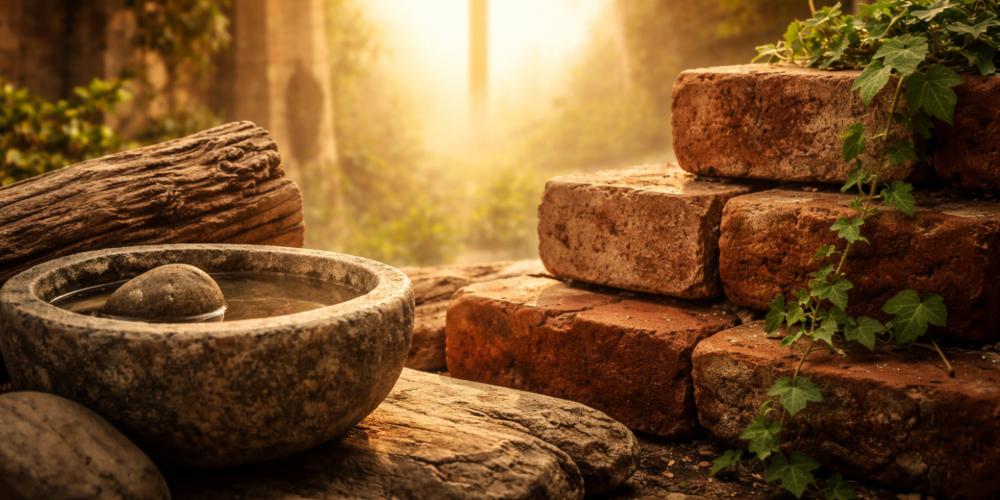
Some beauty is only revealed with the passage of time: stone deepening in silence, wood gaining nobility, and brick revealing its past in every crack. In architecture, natural materials convey authenticity powerfully and simply. There is an essence and a truth within them that becomes clearer over time.
Natural materials reveal their true nature as they age. As the Finnish architect and theorist Juhani Pallasmaa observed, “stone, brick, and wood—allow our vision to penetrate their surfaces and enable us to become convinced of the veracity of matter. Natural materials express their age as well as the story of their origins and their history of human use.”[1] Furthermore, natural materials offer an infinite range of possibilities. “Material is endless,”[2] observed Peter Zumthor. “Take a stone: you can saw it, grind it, drill into it, split it, or polish it—it will become a different thing each time.”[3] Thus, the material becomes a testament to interaction and the complex relationship between humans, nature, and time.
Using natural materials in architecture engages the senses and imagination, transforming time into another dimension, that of human perception of the built environment. Whether it is the increasingly evident and rich texture of stone, the warmth and hues of weathered wood, or the solidity of worn brick, architecture becomes a living and meaningful presence. Architecture built from natural materials not only withstands the passage of time, it also bears witness to it, gradually revealing its authentic and enduring richness.
By contrast, artificial materials such as plastic, painted metal, and treated glass retain the character of a surface without depth. They are incapable of establishing an authentic relationship with people. Over time, their apparent stability inevitably reveals their artificiality and inability to mediate experience. Pallasmaa highlights a fundamental difference—the ability of natural materials to reflect changes and the passage of time gives them authenticity and emotional value. Conversely, artificial materials remain trapped in their own static illusion. Therefore, “the detachment of buildings from the realities of matter and craft further turns architecture into a stage set for the eye, into scenography devoid of the authenticity of matter and construction”[4] and “reinforces the dreamlike sense of unreality and alienation”.[5]
In a broader, yet much more personal, sense, I experience the subtle qualities of natural materials in my relationship with Jesus. This relationship becomes clearer, deeper, more beautiful, and more authentic over time. Those who live this experience do not remain superficial, nor can they remain unchanged. The more time they spend immersed in the atmosphere of Jesus’s life, and above all in His presence, the more clearly the nature, love, and beauty of the Son of God shine through in the person who contemplates them. This transformation becomes increasingly evident, credible, and compelling, pointing to the ultimate source of authenticity.
The story of natural materials is one way I understand how a personal relationship with Jesus can lead us beyond appearances and superficiality towards a deep, sincere understanding of the world around us, ourselves, and ourselves in relation to the divine.
We have a choice: we can either surrender to the web of appearances that alienates us or embrace the transformative implications of authenticity. Ultimately, time discreetly whispers to us that truth and beauty grow together slowly and naturally.