













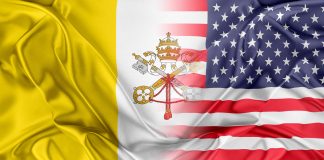
Pope Leo XIV: the relationship between the first American pope and US politics
Pope Leo XIV, who was born Robert Francis Prevost, was elected the 267th Supreme Pontiff. Born in the south of Chicago in 1955, he is the first North American pope. Despite this, his relationship with US politics is more complex than his biography might suggest.

Beauty in brokenness
Amy Ainsworth is the mother of 5-year-old twin girls, whose appearance is both surprising and fascinating – how could it be any other way when you see a pair of big green eyes showing off from behind the brown curls of one of the girls, contrasting strikingly with the coffee-coloured eyes and black, straight hair of her twin sister?

Why do bad things happen to good people?
The question in the title is a protest which expresses a fair amount of suspicion towards God. It is a barely concealed condemnation of God and His actions, the strange rebellion of a world that sees itself as morally superior to God. People forget Scripture's words in the book of Job: Beware lest wrath entice you into scoffing (Job 36:18, RSV).

The noble torment of forgiveness
We know that authentic forgiveness is Christian and desirable. And we also know it feels good to receive genuine forgiveness. But does God ask us to forgive under all circumstances? We often try to discover the answer to such uncomfortable questions about God by looking at those who say they know Him. And, sometimes, we have something to gain by doing so.

The secularization of Christmas
Although the holiday of Christmas does not have a biblical origin and did not exist in the days of the early church, most Christians around the world keep it as a reminder of the miracle of Jesus Christ’s birth. However, the religious significance of the holiday is waning in the Western world, as the number of church members decreases and Bible illiteracy increases.

Jim Ayer | Forever a fisherman
Jim Ayer was, for most of his life, a slave to his own dreams—a fisherman of thrills and addictions. From when he was a child, he attached a ball and chain to each ankle, closed himself up in his own world, and threw away the key.

Lewis and the Lion
We have become so accustomed to authors and researchers being highly specialised in niche fields, that we are tempted to be skeptical of works they produce outside of their accepted field of expertise. It seems bizarre therefore that an author of children's literature could also be a professor at Oxford and Cambridge and an expert on the medieval era.

Love does not give up
We love people for who they are. But there is a kind of love that is too high for us to truly comprehend in all its nuances, a love that manifests itself towards people no matter who they are or what they become. We find a love such as this in the beautiful story of Ian and Larissa.
Turning our backs on Infinity
It is known that many Jews, some even contemporaries of Jesus, claimed to be the expected Messiah. Of these, only Jesus of Nazareth is the name that has endured over time. Still, too few of His contemporaries[1] recognized and accepted Him as the Messiah, and this reality raises a question: why was Jesus rejected?

Religion is what’s in my heart: true or false?
"Religion is what is in my soul. No one can take away what is there. But in public we have to comply..."

Is Christianity merely an emotional experience?
"Yes, we eat grass and we're proud of it because it demonstrates that, with God's power, we can do anything," is the statement and belief of young Rosemary Phetha as reported in TimesLIVE.

The Dutch Arminians
On the continent jaded by an irrelevant religion, a new denomination appeared, in addition to the Lutheran, Calvinist, and Anglican Protestants—the Arminians.
The grace of having a vulnerable God
“All need Thee, even those who are unaware of their need—these most of all. He who hungers goes in search of bread and knows not that his hunger is for Thee; he who thirsts imagines that his longing is for water, but his thirst is for Thee; he who is sick believes he is seeking health by many means, and his sickness is ...


My stellar moments
It is said that God works through people. I am convinced that the people evoked in connection with my stellar moments—and I really would have liked to name them all—each contributed, in their own way, to my reunion with Divinity.