










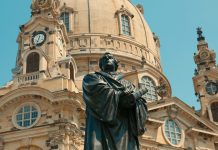



How authentic is my life?
When one pays attention to the finer details, any life story can be interesting. When you go into detail, any common or mediocre story that could have been summed up in only a few words, becomes a confession. I realise that my own story is no exception, although it has often seemed to me that I live a banal and predictable life.

Love and cosmic cold
"We keep on being told that religion, whatever its imperfections, at least instills morality. On every side, there is conclusive evidence that the contrary is the case and that faith causes people to be more mean, more selfish, and perhaps above all, more stupid." (Christopher Hitchens)
The immortal Bible
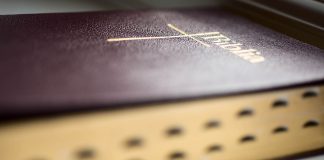
"Scripture" is a Latin word that means "writings", while "Bible" is a neutral Greek plural meaning "books" (from biblíon = book, document, scroll). Today, however, in all languages, the word "Bible" is understood as a feminine singular, meaning Holy Scripture.
What do Jesus’ miracles mean?
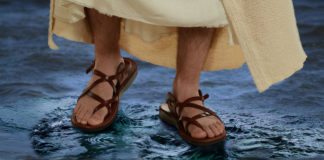
It’s hard to read the description of Jesus’ life in the Gospels and not wonder what the many supernatural healings and other miracles performed by Him mean for us today.
Son of God
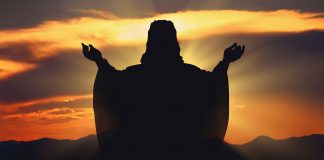
Even in this secular age, the world’s largest group of religious believers—a full third of Earth’s human population—worships Jesus of Nazareth as the eternal God who appeared in human flesh. Millions more—Muslims, Baha’i, Hindus, Buddhists and others—recognise His unique connection to the Divine, His wisdom and His compassion.
COVID-19: Hope ordinances and a divine governance
Fines, military ordinances, police and army patrolling the streets – this is the reality we have suddenly found ourselves living in. It is a tightening reality, a rigid corset-like structure of rules.
How to study the Bible properly
Do your best to present yourself to God as one approved, […] who correctly handles the word of truth. (2 Timothy 2:15)

What did I miss about God in my 20s?
I was twenty when I first became curious about God. I was fortunate to see His presence in the lives of my friends and longed for that same presence in my own life.

Jesus: Where two worlds meet
Un hombre pasa con un pan al hombro.../Otro busca en el fango huesos, cáscaras/¿Cómo escribir después del infinito?

Interpreting Bible prophecy
How can we correctly interpret Bible prophecy? What safety criteria can we use to avoid falling into the trap of hasty and erroneous interpretations?

How I came to believe
I was a pagan as a child. Not by choice, but as a consequence of lacking any access to the Word of God. In the 1980s Romania, catechizing an Orthodox child (whose parents were members of the Communist Party) was a highly unlikely event Pavlik Morozov’s myth, the hero-child that denounced his own father, generated caution.
The opposite of love is not hatred (part 2)
Why couldn’t God simply have forgiven sinners? Precisely because sinners cannot be forgiven until they completely understand sin, with all its far reaching consequences, or before the wages of sin are paid.

Fear of war: how to soothe our hearts
When the fear of war overwhelms our thoughts, let us not forget that we are not alone, that God will end our suffering and give us a new and everlasting life.

The tower dedicated to pride
Jeddah is different, at least according to its city motto. This Saudi Arabian port city on the Red Sea is home to more than 4 million people and is a gateway to Mecca: the holiest city in Islam. Millions of pilgrims come through Jeddah to visit Mecca, some 65 kilometres to the east, and Medina, Islam’s second holiest city, 360km to the north.

Together to the end of the road
The journey "through the valley of the shadow of death" has never been easy. However, it has become increasingly lonely as our unfamiliarity with death has made us awkward and reserved when interacting with the dying.