












Hungry for youth and immortality
Crouched in the trenches of the horror of old age, modern individuals no longer wish to recover anything from the natural ageing process that their ancestors practised with such serenity. On the contrary, the first signs of physical decline become the raw material for a wide range of efforts (from picturesque to sickly) to forge a youth that the mirror refuses to restore.

Does God listen to my prayers?
If there is a crossroads where both the path of faith and the path of doubt or unbelief begin, it is prayer.

“Love yourself” | How biblical is the concept of self-care?
Widely discussed in recent years, the term self-care generally refers to focusing on the needs and goals that contribute to our well-being. “Love yourself!” has become the motto of this “ultimate form of self-care,” which some Christians see as a stepping stone toward loving and caring for others. But just how biblical are the ideas of self-love and self-prioritization—concepts so deeply woven into...

The second reason to forgive: the “Justice” you refuse to let die will not let you live
Following several surveys (1988, 1991, 2009), the Gallup organisation revealed both good news and bad news. The good news is that 94 percent of people believe forgiveness is very important. The bad news is that 85 percent admit they are not ready to do it on their own.

Saving discipline: God’s rod?
The saying Spare the rod and spoil the child is deeply rooted in some cultures as saving discipline. Where does this idea come from and is it true that using the rod is next to godliness?

Vitamins, explained from A to K
We all know that vitamins are good for us. Many of us take supplements to boost the supply of vitamins in our bodies. However, it wasn’t until 1912 that Polish biochemist Casimir Funk actually came up with the concept of vitamins, which he called "vital amines."

Costly choices
One reason, if not the reason why the story of humanity's first wrong choice, the original failure, is vehemently denounced is the brutality with which this event—a seemingly trivial "dietary" decision that turned out to be the most costly ever made by a human being—reminds us more powerfully than any other story how painful the consequences of our mistakes can be. We do...

A story of imperfection and grace
Sometimes I think I was born with a magnifying glass in my hand, one through which I critically scrutinize everything I do and say and which relentlessly magnifies every imperfection.

Until love do us part
We see it in movies, read it in modern children’s stories, and hear it in romantic songs: love is the most beautiful, most desirable, and most precious asset of humanity. Many argue that if there is anything that can save the world from itself, it is love. But how is it that love itself has led to profound systemic issues, by dissolving the...

Gifts for good
When I was in my mid-twenties, I attended a university in Brisbane, Australia, two hours from where I lived. I had a friend in the city who I’d sometimes stay with to avoid having to travel back and forth on back-to-back uni days.

Are Christians better equipped to make decisions?
"All your life long you are slowly turning this central thing into a heavenly creature or a hellish creature" through the decisions you make, wrote CS Lewis. If the choices we make really have such an impact, how can Christians make sure they make the right decisions?

Time robbers and masters of time
How did the phrase “time is money” come to steal the true meaning of time? Time is not money, it is life.
The Ecumenism Files Part I: From the Apostolic Church to the Great Schism
In the face of the hundreds of Christian confessions that exist today, the ecumenical efforts of the last decades have invariably raised some complementary and equally legitimate questions: Is Jesus' desire "that all of them may be one" (John 17:21) possible?
“A Time to Forgive” | Book Review
"A Time to Forgive" is the story of a pilgrimage through the void of pain and trauma. A father, devastated by the enormity of his loss, struggles to forgive his daughter's killer.
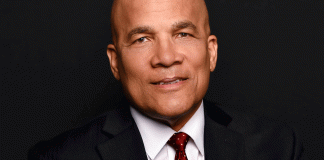
The marathon runner with a mission
Dr Delbert Baker is an African-American pastor, writer, teacher, and former president of Oakwood University in Huntsville, Alabama, a historically Black Seventh-day Adventist institution of higher learning. The conversation with Dr Baker took place in Nairobi, Kenya. With Kenya being the country of marathon runners, much of the discussion was about the races he participated in and their remarkable results.