














Positive thinking overdose: Why too much optimism is harmful
If optimism helps us get rid of problems more easily, too much optimism does the exact opposite: it amplifies them. Pushed to the extreme, positive thinking prescribed as an antidote to suffering prevents us from accepting reality as it is and starting to look for solutions that can make our lives easier.

Life as a couple after the first child
The arrival of a child brings immense joy and fulfilment, but it also introduces a new dynamic within the family, a reality that places the couple in the position of taking on responsibilities and tasks they had not encountered before. Transitioning to life as a family of three is a stage that disrupts the daily routine, demanding the full attention and involvement of...

Movies and the fascination with good
Starting with biblical stories, moving on to myths and legends, and finally reaching the contemporary film industry, people have always been fascinated by heroes. But what makes us look for heroes? What do modern heroes look like and what do they mean to the contemporary world?

Why it’s okay to let your children get bored from time to time
The refrain: “I’m booored…” is “the worst song on the parenting soundtrack,” says journalist Kat Patrick humorously. Chanted in the most inconvenient moments, this complaint often triggers the parent’s guilt or concern. But there’s nothing wrong with letting your child get bored sometimes.

How to speak to be heard
“The problem with communication is the illusion that it has been accomplished.” (George Bernard Shaw)

Dislike for the likes that manipulate us
Paris, November 13, 2015. A European capital is struck cruelly by fundamentalists who justify their crimes in the name of something sacred—an event that shocked the entire world. It was neither the first nor, unfortunately, the last tragedy whose impact on the public has become a subject of analysis.


Give a little, change a lot
Seeing a team care for remote villages in the Solomon Islands showed me how small donations can make a real big difference.

Divorce among conservative Christians
In America, conservative Protestants seem to divorce at least as often as people of other religious orientations. The idea has become an opportunity for finger-pointing and accusations of hypocrisy, but this is only proof that the statistics are misinterpreted.

How to forge friendships from resilient material
The whirlwind of activities and deadlines that adult life throws at us often makes us resistant to closeness. We abandon old friends and neglect building new relationships until inevitably, the day comes when we start feeling pressed against the self-erected walls of loneliness.

My mechanism of resilience
When I was four years old, my younger brother was born. My parents focused on my brother and spent less time with me. It was only 40 years later that I discovered how this had affected me.

The saving emotional intelligence
“Many people feel out of touch with their feelings. Counselor offices and publishing houses have proliferated thanks to the need to help people to improve their communication skills, to restore their self-confidence and to help them relate to other people.” – Sir Ken Robinson, Out of Our Minds: Learning to be Creative
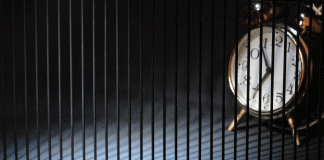
Caught between the hands of a clock
Since Hans Selye introduced the concept of stress into the language of science almost seven decades ago, it has now become firmly rooted in our vocabulary and permeates all levels of everyday life. One common cause of stress, though unevenly distributed among us mortals, weaves enough threads into its intricate fabric that it cannot be entirely avoided: the relationship with time.

I shall not hate
Izzeldin Abuelaish wrote a book titled I Shall Not Hate, now translated into 13 languages, about the hatred that led to the death of his daughters. "Hate is a poison, a fire which burns you from the inside," he writes.

Don’t believe everything you think
Your brain produces thousands of thoughts every day. Not all of them deserve your trust.