














The “background noise” of free will
What would you say if you read an article that tells you that the human ability to make choices freely and consciously—that is, free will—might just be an illusion? What if the article backs up its claims with scientific research? Such curiosity is sparked by an article published on livescience.com.

About motivation, comfort and procrastination…
I accepted the challenge of writing about motivation thinking it was an easy task, after so many motivational speeches read, listened to, or given.

Colour you happy
Happiness is . . . ? How would you finish the sentence? What do you think happiness is? Positive psychologist Sonja Lyubomirsky, in The How of Happiness, says it is is “the experience of joy, contentment, or positive wellbeing, combined with a sense that one’s life is good, meaningful, and worthwhile.”

An encounter with kindness
Sartre may have been right when he said Hell is other people. Yet, for some, their first step toward Heaven is meeting the God who shelters in someone else's soul.

A story of imperfection and grace
Sometimes I think I was born with a magnifying glass in my hand, one through which I critically scrutinize everything I do and say and which relentlessly magnifies every imperfection.

The kindness that wipes away the effects of daily stress
Daily stress is a good excuse to avoid other people's needs, but this choice is a double loss. The kindness we display to make other people's days better is a very strong antidote to the high level of stress we experience daily.

Compromise and the right price
Compromise is always present in relationships. It may pull us down, but it can also be a good reconciliation exercise when there are differences that cannot be resolved in any other way.
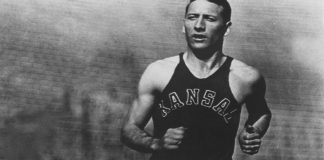
The boy who didn’t believe in ‘impossible’
We know their stories, or we think we know them. Theirs are stories of success that earn the admiration of the entire world. We see the moment of victory and wish we could be in the place of the victorious ones, without realising the effort and sacrifice that are behind that moment of glory. If we truly grasped this, we might become more...

The ideal of a couple
I recently watched a TV show in which the guests, which included professors and psychotherapists, when asked about the feminine ideal in the contemporary world, expressed opinions that seemed strange to me: that such an ideal would no longer be detectable or would no longer have a purpose, today...

COVID-19: A hundred remedies for solitude
I open the window and breathe in the air, trying to guess the weather. Floating around, mixed, are scents and miasms alike; it's hard to decipher these intricate clues.

Saving creativity
An experimenter is like a hunter who, instead of waiting quietly for game, tries to make it rise, by beating up the locality where he assumes it is. – Francis Bacon, 17th-century English philosopher

Monday: how to survive the toughest day of the week
Monday! This cruel, heartless day of the week robs us of comfort and freedom and plants us right in the middle of professional responsibilities. If we were to order the days of the week by popularity, Monday would probably end up in last place.

How do I learn to really enjoy life?
I don’t remember much about the moment. I remember its warmth, and the way it glowed with purpose and spirit. But the stage is blurry. The song which pulsed out from it is uncertain. I know it came from a good friend of mine, one whose spot-lit glory provoked in me no jealousy, no feeling of being left out.

The need for clarity
More than ten years ago, I received a book for my birthday. The message inside the gift said: The Bible is the Lord's love letter to humankind. I give you this book with the hope that the reply mankind gave to God will also nourish your soul. Happy birthday! And, indeed, so it was.

8 signs that show you are an introvert
Detecting an introvert is not as easy as we may think, because sometimes introverts are not shy or silent at all, they take responsibility, work extraordinarily in teams, and can even be skilled public speakers. Yet several traits can unveil the introverted character of an individual.