














The big impact of small acts of kindness
An unexpected act of kindness can change a day—whether you are on the receiving end or the one who initiates it. And that change can echo far beyond a single day, because when measured by their effects, acts of kindness are never truly small, despite the language we use to describe them.

How people have viewed earthquakes throughout history
Earthquakes have always struck fear into the hearts of people who didn't know why the earth was shaking but who saw how easily their possessions or loved ones could be lost to such tremors.

How to cope with manipulation
Many of us probably know at least one manipulative person — or perhaps we’ve even caught ourselves falling into that category. But do we really know when this tendency to control or influence others becomes harmful? And more importantly, how can we deal with manipulative people?

Why do our parents believe fake news, and what can we do to help them?
The misinformation crisis affecting older adults is real, well-documented and growing. Here's what the studies say about how to tackle it.

Brethren Assemblies | The history of the Brethren
The history of Brethren Assemblies begins in the 19th century, when groups of British believers began to be dissatisfied with the Anglican Church, which they saw as enslaved to the state and which they considered to be abandoning the fundamental principles of Christianity.

The first Christmas gift-giver
In writing this article, I asked a handful of people what the worst thing they had ever received for Christmas was. The answers I received were interesting, to say the least.

Does prayer work?
As a book editor who works in a Christian publishing house, I know prayer works from a sales perspective. Books on the topic of prayer are consistently among our best sellers. It seems that many of our customers and readers—mostly people of faith, but including people who are interested but uncertain about faith—are keen to be reassured that prayer works and to find...

The Second Coming Files: A 2000-Year Investigation | Part VII: Adventism After the Great Disappointment
At the end of a journey tracing how the belief and hope in the Second Coming of Jesus have manifested themselves in the two-thousand-year history of Christianity, the final part of The Second Coming Files presents the remaining elements that link that history to the present day: the Millerite movement and Adventism.

How to grow together with God
We’d been married only a few weeks when we discovered that growing our spirituality as a couple was going to be much more complicated than the instructions on the packet suggested.

Spoiling is not love
Being a parent means, among other things, engaging in agonising negotiations to keep the supermarket aisles relatively quiet and the shopping trolley from overflowing with sweets. Some are successfully concluded. Others, a real failure. Although we are very adept at recognising a spoiled child on the street, we have a much harder time spotting the signs in our own children. After all, what...

Why should you tell your friends your secrets?
In 2004, Frank Warren, an American businessman, had "a crazy idea," as he himself describes it. He printed 3,000 postcards, wrote his address on them and a series of instructions, then left space on the back for the sender to write secrets they had never shared with anyone before.

The unlikely story behind a blockbuster
In one sense, it was hardly an unusual story: a big-budget Hollywood war movie with a big-name director and famous actors, featuring long and ultra-violent action sequences, with heroes and enemies.

The false dilemma: Are there really only two choices?
The false dilemma fallacy presents an issue as if there are only two ways to solve it—often, two opposite ways—when, in fact, there are more ways than that. The conflict between the two ways presented is also false.

In the world of “what if” | Why we are drawn to counterfactual thinking
The ability to imagine alternatives to events that have already occurred distinguishes humans from other creatures and machines—artificial intelligence has not yet succeeded in creating a device that can devise counterfactual scenarios. The fact that we can travel in an imaginary time and rewrite our actions and their outcomes can prove to be an advantage or can lead to dysfunctional emotional and cognitive...
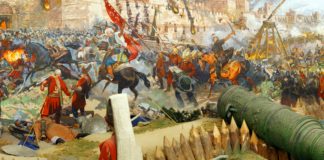
Fighting over the West: Orthodoxy, Protestant Reformation, and Catholicism
At the beginning of the 15th century, the threat of the Ottoman Empire to Eastern Europe was a painful certainty. The last Byzantines, aware of the ensuing disaster, called on Western aid, seeking political union with the Roman Catholic Church.