













God on trial
The scenario in which God is a judge and His creatures are subject to His judgment culminates, in the Bible, with a happy ending for all lovers of righteousness. But what would be the end of a situation in which God is the accused in a trial instituted by His creatures? Whose ending would be happy?

What’s growing on your family tree?
From a distance, it looked like a simple picture of a tree: nothing very artistic—more of a sketch in subtle shades of brown and green. But as I looked closer I noticed something unusual. The tree had been constructed out of words and phrases. Someone had collected snippets of information about their family and their ancestors, and written it down to form the...

Behind the scenes of acts of kindness done at Christmas
The holidays are a time of generosity, when those forgotten by the world meet those who want to forget that sadness exists and, out of the coexistence of the two needs, something good is born.

The role of hope in healing from “survivor’s guilt”
I don’t think I did anything significant the afternoon I saw the movie “Awakenings”. The feeling that I had reached the heart of the human condition strongly impressed me with the idea that we are born captive in a limited nature, and that gave me a heavy feeling of loss.

The Church of England | Anglicanism between Rome and Geneva
The term "Anglicanism" denotes the system of doctrine and practice of those Christians who are in communion with the archbishop of Canterbury. The beginnings of the Church of England are linked to the reign of Henry VIII and Edward VI, while the initial formulation of Anglican principles is linked to the reign of Elizabeth I, during whose reign a middle ground was politically...

COVID-19: What have we learned about ourselves?
Courage is not the opposite of fear, nor of caution. True courage is what you do right in the midst of fear.

The prayer meeting that toppled a regime
How a small group of faithful Christians instigated the end of Soviet-controlled East Germany.

A day on the golf course and the unexpected effects of trauma
Douglas Jacobs has a long pastoral and academic career, as well as many hobbies and interests. An accidental witness to an armed incident that changed his perspective on life and death, he shares his surprising experiences and lessons learned.

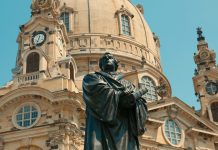
The saint who hated God
Martin Luther believed that he knew exactly what God expected of him, and in the tireless endeavour to please God, he came to the point of hating Him.

It all adds up
We try to protect them as much as we can from the evil and the ugliness in this world, maybe because we know that indifference does not fit in their heart as easily as it has made a nest in ours. And maybe that's why children are the ones who give us amazing lessons of sacrifice and altruism.

How to give your money away and make it count
A seemingly endless stream of needy causes compete for our attention and money every day. Our emails, mailboxes and phones are bombarded by charities asking for generous donations to help.

Born again | The unimaginable personal change
Jesus replied, “Very truly I tell you, no one can see the kingdom of God unless they are born again” (John 3:3).

The stable with the iron bars
At the end of every year, a covert censorship obscures the true meaning of the event that split history in two: the birth of Jesus. Under the festive guise of Christmas, the celebration of the birth of Jesus Christ has been culturally transformed into a holiday of good cheer. The religious motif has been preserved, but the spiritual meaning has largely been lost.

Who Am I?
I guess my mid-life crisis kicked off when I turned 26. What is my purpose in life? What have I accomplished so far? Am I caught in a treadmill of mediocrity? Who am I? Am I basically a good person or a selfish person? Do I have a destiny? These kinds of questions have a way of recycling themselves—they turned up again around my 31st birthday,...

Simple purpose
Recently, I went trekking in Nepal. Sometimes upon returning from a trip, I feel the pressure to return with exciting stories—the near-death experiences and anecdotes that leave people wide-eyed and laughing.