









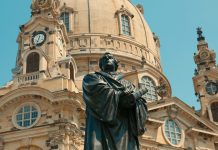




Depression, the silent killer
In 2020, depression became the second leading cause of global morbidity and it is projected to be the first in 2030,[1] according to a forecast by the World Health Organization (WHO).

Does divorce make us happier than continuing in an unhappy marriage?
At the age of 27, for the first time in my life, I worried that time was passing too fast. For the next few years, the speed with which most of my friends were getting married was the next source of concern.

Picturing heaven
What do you imagine heaven will be like? American science-fiction writer Isaac Asimov famously said, “For whatever the tortures of hell, I think the boredom of heaven would be even worse.” Although I love Jesus, I think I am a bit afraid of getting bored there too. There’s a prevailing picture of heaven as being some sort of suspended animation, which may play into this.

From bootless boy to life-changing footballer
Footballers are often in the headlines for their off-field antics more than their on-field achievements. So, it is no real surprise that the greatest story to come out of the AFL is not about a nail-biting final or freakishly skilled player.

COVID-19: Those who “would have died anyway”. How much is a human life worth?
Discussions about the reasonable number of deaths in a pandemic, about whether or not the price for saving people is killing the economy and, ultimately, debates on a life’s value were brought to the fore by the COVID-19 pandemic.

Working with a toxic boss
When professional activity causes constant stress, it is necessary, as part of a strategy for better communication, to identify the traits of a toxic boss and decipher problematic behaviours.

Non Sequitur: A forced conclusion is not really a conclusion
Needing to process a multitude of complex information in a short amount of time can lead to erroneous reasoning. When a conclusion is supported by weak or irrelevant arguments, the reasoning falls into the category called non sequitur—does not follow, or irrelevant argument.

Strong prayers to the hidden God
No one has ever seen God, but the One who knew Him before He was born on this earth taught us all to address Him in prayer.

Double the joy, half the trouble
And they lived happily ever after. This sentence closes many of the stories we often read in just a few minutes. In reality, between the beginning and end of a love story lie years of experiences and events which, at times, can be more difficult than they seem.

A song of hope
Of the hundreds of carols composed and sung at Christmas, one has managed not only to survive for more than two centuries, but also to spread its message of hope to all corners of the world.

Is the end of something better than its beginning?
The question, "Is the end of something better than its beginning?" nuances the statement of Solomon, who is considered in the Bible the wisest man who ever lived.
The missing filter
At a time when the abundance of information makes it imperative to talk about information hygiene, critical thinking should be the first missing filter we talk about.

The Church in mourning: Serving the bereaved in practical ways
When it comes to dealing with grief, psychotherapist Francis Weller points out that "it takes outrageous courage to face an outrageous loss". By supporting those who are bereaved, the Church shows that it possesses the qualities needed to balance concern for current suffering with faith in the ultimate victory over death.

No one Googles censorship
Over the last decade and a half, various legal disputes have brought to the attention of the public the issue of the social responsibility of Big Tech companies to control the flow of information on their channels. But in mid-January 2021, people of all ideological colours had indisputable proof that the decisions of technology giants have ramifications that go far beyond the commercial...

Digital natives, digitally naive: life at the dawn of another revolution
The generation born with the tablet and the smartphone in its arms, but which ends up being exploited by big data cultivators and controlled by radicalization and polarization, can become the generation that implements anti-democratic movements.